
Norwich, England · Private residential landlords
Norwich consults on two landlord licensing schemes
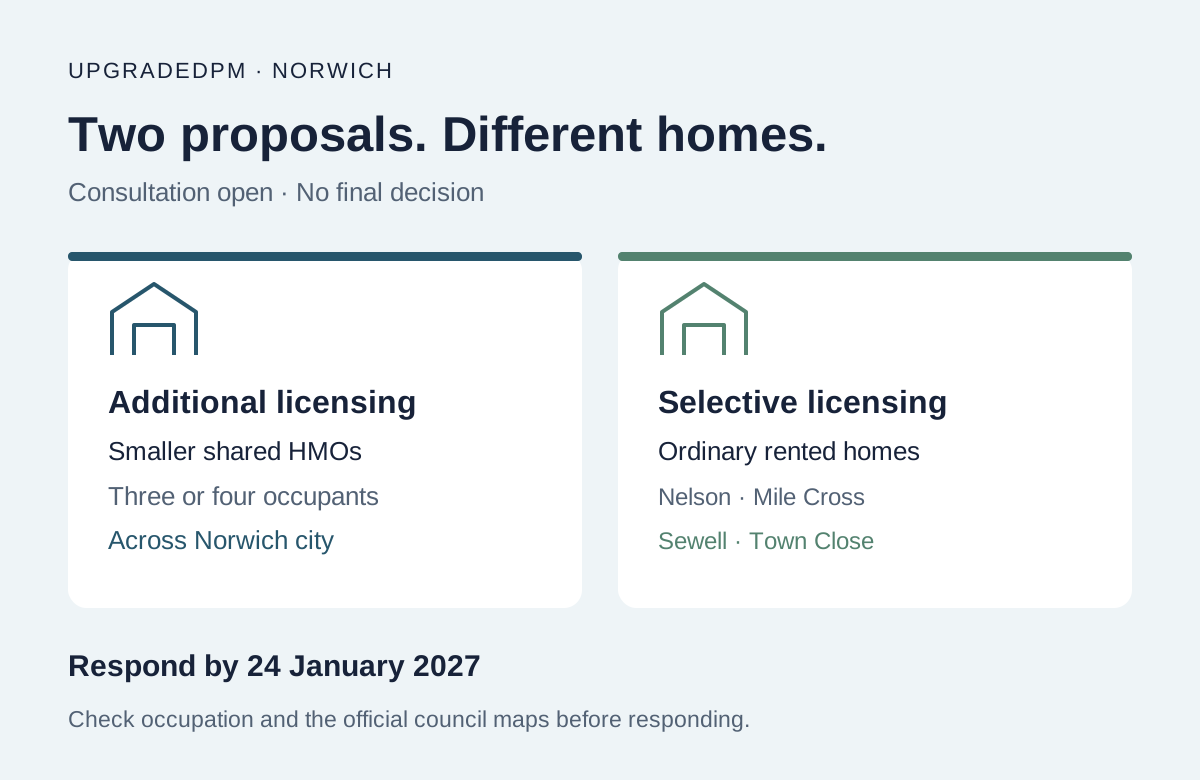
Norwich has opened a consultation on two proposed property licensing schemes. One concerns smaller shared houses across the city. The other covers ordinary rented homes in four wards. Neither is an instruction to apply or pay today. Check which proposal you would be responding to before the consultation closes on 24 January 2027.
2 November 2026
Consultation opened
The council is seeking views on two proposed schemes.
24 January 2027
Responses close
The original consultation summary and FAQ confirm the closing date.
Spring 2027
Further consideration expected
The council expects to consider the responses before deciding whether to proceed.
Before you respond
Start with how the home is occupied
Choose the nearest example, then check the council’s documents. This does not determine whether your property needs a licence.
A larger HMO already needs a licence
Keep the current licence and its conditions in view. The proposal concerns smaller HMOs outside mandatory licensing. It does not replace your existing licence or add a selective licence to a property covered by mandatory licensing.
Three or four people share the home
The additional licensing proposal is citywide for HMOs with three or four occupants forming at least two households. Check occupation, shared facilities and the council boundary. Ask the council about any uncertain or exceptional arrangement.
One household rents the home
Check the selective proposal and official map for Nelson, Mile Cross, Sewell and Town Close. A citywide HMO proposal does not mean that every ordinary rental across Norwich is included.
Which part of the proposal concerns your property?
The council’s announcement on 2 November describes a proposed citywide additional licensing scheme for houses in multiple occupation, or HMOs, with three or four occupants forming at least two households and sharing facilities. The separate selective licensing proposal concerns privately rented homes occupied by one or two households in Nelson, Mile Cross, Sewell and Town Close.
These are different routes. A property covered by mandatory or additional HMO licensing would not also need a selective licence under the proposal. Existing mandatory HMO licensing remains separate. The consultation does not suspend a current licence or the need to manage a home safely. Check actual occupancy and household arrangements rather than assuming the number of bedrooms settles the question.
Check the council boundary before using a ward name
The council publishes a proposed additional licensing map and a separate proposed selective licensing map. Use the correct map alongside the property’s location and occupation. A Norwich postal address alone does not establish that a home falls within the city council boundary or one of the four proposed wards.
For an uncertain boundary, a converted building, a resident landlord or an unusual occupation arrangement, ask the council which part of the proposal it considers relevant. The summary cannot determine every exemption or individual case. A holiday let should not be treated as an ordinary residential tenancy merely to fit one of these descriptions. Our UK permissions guide explains the separate checks before short letting.
The figures are proposed fees, not a bill due now
The proposed fee schedule puts a standard additional HMO licence at £1,000, split into £500 with the application and £500 following a decision to grant. For selective licensing, the proposed standard total is £700, split into £350 at each stage. These are proposed totals for a licence normally lasting up to five years, not annual charges.
The documents also propose discounts, subject to their conditions. Both the fees and the schemes may change after consultation. An owner can assess the possible cost and comment on whether it is proportionate, but should not record a proposed fee as an existing demand. Keep any current mandatory licence, its renewal and its charges separate from this exercise.
A useful response explains the practical effect
The consultation page provides the questionnaire, evidence, draft conditions, fees and maps. Identify the proposal you are commenting on, the relevant property type and the issue you want the council to consider. Explain how a condition, fee or alternative approach would work in practice, rather than answering as if both schemes covered every rental.
Use the blank response record to organise the documents checked and the questions still unanswered. Keep tenant names, financial records and private correspondence out of a general consultation response. Read the questionnaire’s information about use of responses before submitting. Saving your own note is not sending a response to the council.
The original summary document and FAQ confirm 24 January 2027. The consultation landing text currently prints 2026 for the closing year, which conflicts with those documents and the dated council announcement. Use the original documents to check the deadline.
There is no final scheme or fixed start date
The council says no final decision has been made. Responses are expected to go to Cabinet in spring 2027. Its announcement says an approved scheme would not begin before late summer 2027, with notice to those affected. That is a conditional timetable, not a confirmed commencement date. The final boundaries, conditions and fees still need a decision.
Local licensing and national renting rules also have different purposes. The consultation FAQ distinguishes these proposals from the Private Rented Sector Database. Keep the council’s eventual decision alongside your existing records, and use our Renters’ Rights guide for the separate national tenancy position.