
England · Planning applications
Planning decisions in England change on 31 October
From 31 October, national rules will determine which planning applications must go to officers and when a committee referral is possible. If your property plans depend on a council decision, check the route before relying on a committee hearing.
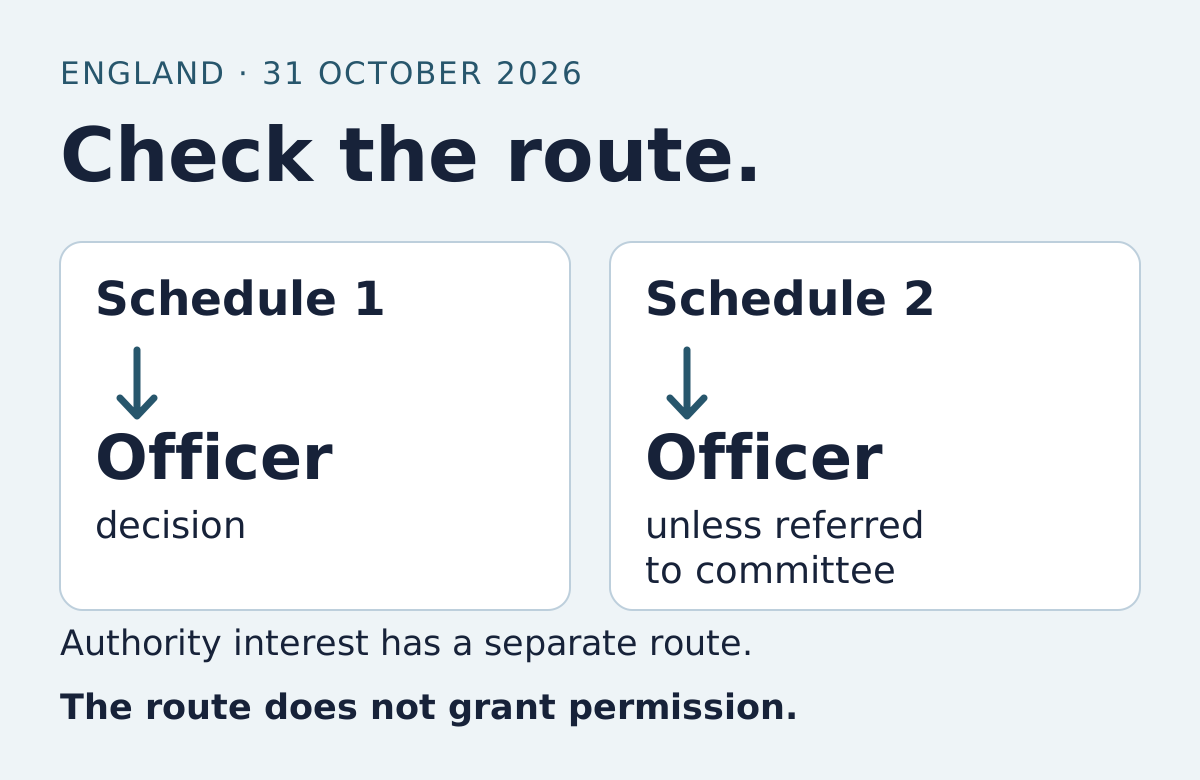
Check the authority, the application type and the published decision route.
Check who will decide the application
England’s national planning delegation regulations were made on 15 July and come into force on 31 October 2026. They change the decision route within covered planning authorities. They do not grant permission for an extension, a conversion or a holiday let.
The accompanying statutory guidance explains that old automatic routes to committee, such as a ward councillor calling in a case or a set number of objections triggering a hearing, will no longer be possible under the national scheme. An owner should establish the actual route for the application rather than build a plan around getting a committee slot.
Start with the right authority. The scheme applies in England, with exclusions including National Park Authorities, the Broads Authority, development corporations and the Homes and Communities Agency. A property’s postal address does not always identify its planning authority. These regulations do not introduce the same procedure in Wales, Scotland or Northern Ireland.
Find the category before assuming the route
Schedule 1 applications must be decided by an officer. Its categories include householder applications, minor commercial and minor residential applications, lawful use certificates and permitted development prior approvals, subject to the Schedule 2 and authority interest exceptions below. An officer decision can approve or refuse an application. It is not a lighter form of permission.
The residential definition needs care. One part covers development consisting only of dwellings and incidental development, with one to nine dwellings on a site smaller than 0.5 hectares. There is a separate provision for incidental development at a building containing flats, excluding a change of use or a change in the number of flats. Counting fewer than ten homes does not settle every application’s category.
Ask the council or your planning adviser to identify the application type and any connected consents. Keep its reference, the drawings being considered and the answer about the decision route together. That gives you something concrete to follow when the proposal changes or a new document appears on the planning register.
A possible referral still needs the right grounds
Schedule 2 also starts with officer determination. A committee referral needs agreement between the nominated officer and nominated member, and a qualifying issue of local economic, social or environmental significance, or a significant planning matter assessed against the development plan and other material considerations. A request for a hearing is not itself a referral.
Listed building consent, connected planning applications and retrospective applications are among the Schedule 2 cases. Within the two schedules, applications involving an interest of the authority, its members or officers have a separate route under regulation 6. Do not classify a case solely from its size or from how the neighbouring property was handled.
For example, an ordinary householder proposal and a retrospective proposal can have different routes even when they concern similar work. If you think a referral should be considered, ask how the authority’s published arrangements work and explain the relevant issue. Avoid assuming that collecting more objections will produce a committee hearing.
Put the useful evidence into the application
Keep the planning case clear whichever route applies. Explain the proposed use and works consistently, refer to the current drawings and provide the evidence needed to assess their effects. Where a concern has led to a revised plan, make clear which version answers it. A long argument about who should hear the case cannot replace missing information about the proposal.
Check the council’s current planning register, consultation dates and published delegation arrangements. Save the application reference and any relevant correspondence. If you are helping a neighbour understand your plans, show the actual proposal rather than promise that a councillor will secure a particular outcome.
Our blank record gives you a place to keep the authority, application type, decision route and outstanding action together. It is an internal working record. An application acknowledgement, a committee agenda entry or an adviser’s expectation is not a grant of permission.
Check a pending case before committing to a date
If an application is already in progress, ask the authority how it will handle the decision from 31 October. The guidance requires councils to comply from that date. Do not assume that submitting earlier preserves an old automatic call in arrangement, or that a hearing you expected remains the correct route.
Keep builders, funding and letting plans aligned with the actual decision and its conditions. An officer route does not promise a faster answer. A proposed meeting date does not establish approval. Where a condition needs a later approval, establish what must happen before the relevant work or use begins.
If the authority’s website still describes an older route, seek a current answer from the planning team and retain it with the case. Follow the application itself rather than relying on a general announcement or the timetable for another property.
Keep the proposed property use clear
A property owner considering short stays still needs to establish whether the intended use is lawful and what permissions the particular property requires. The delegation scheme is not a new holiday let use class, a removal of an Article 4 direction or a change to licensing. The fact that a planning officer will decide a case does not answer those questions.
Our UK property permissions guide explains how planning, licences, the lease, finance and insurance can affect the proposal. Use that wider check alongside the application’s decision route. A favourable answer from one part of the process does not settle the others.
Before accepting bookings or starting work that depends on a decision, read the decision notice and the conditions that apply to the exact proposal. Where the route or the lawful use is uncertain, take property specific planning advice. This update explains the national procedure starting on 31 October, rather than deciding an individual application.