
How much should you charge for Airbnb cleaning?
Start with what it takes to hand over a genuinely clean home. Then work out how much of the bill your cleaning fee should cover, and what the whole stay will cost the guest.
Work out your fee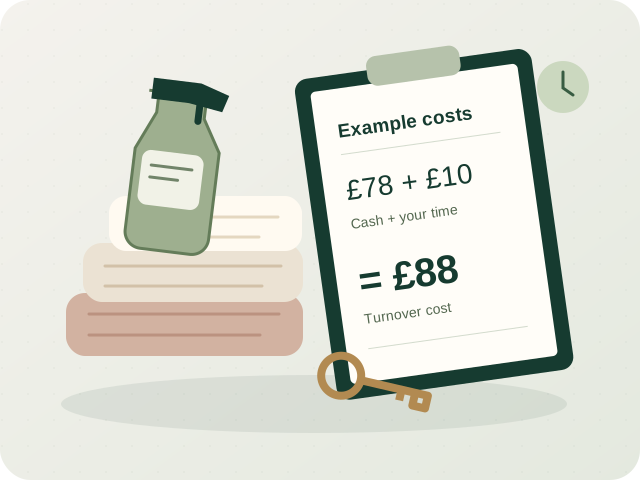
The cleaner’s invoice is only part of it.
You can charge £60 for cleaning and still lose money on every changeover. You can charge no separate cleaning fee and cover the work perfectly well through the nightly price. The label does not settle the economics.
The useful starting point is the cost of getting the property ready again, including the jobs that happen away from it. Someone has to strip the beds, get linen washed and dry, restock the basics, travel to the home and spot the problem before the next guest does. If that person is you, their time has not suddenly become free.
Our view is straightforward. Know the full cost first. Decide deliberately how much to recover through the fee. Then compare the complete guest price for the stays you actually want. Copying the neighbour’s cleaning fee misses all three.
Four hours between stays is not four spare hours.
Imagine an 11am checkout and a 3pm arrival. That gives you a four hour access window, not a promise that four hours of cleaning will fit. Travel, a late departure, washing that still needs drying and the final inspection all compete for it.
Two people working for ninety minutes use three labour hours. A washing machine running for two hours does not add two paid hours if nobody is attending it, but it can still delay the linen being ready. Keep paid time and elapsed time separate when you cost the job.
Cost the handover, not just the hoovering.
Time the complete job.
Measure an ordinary changeover and an awkward one. Count bed stripping and making, bathrooms, kitchen appliances, floors, rubbish, restocking and the final check. Record how many people worked and for how long. A two hour visit by two cleaners is four labour hours, before any off site work.
Ask a provider what the price includes. Does it cover the whole booked sleeping arrangement, linen collection and delivery, consumables, parking and an inspection? Is VAT included where applicable? If laundry is already in the quote, do not add the same laundry bill again. If an employed team does the work, use the full employment cost for those hours rather than just the hourly pay figure.
Linen takes more than a washing cycle.
Count the actual beds in use, towels, bath mats and any sofa bed bedding. Washing, drying, folding, transport and storing enough clean stock all have a cost. Home laundering needs machine running costs and your handling time. An outsourced invoice may already include several of those jobs.
Allow for the ordinary replacement of worn or stained linen, but keep the first purchase of a complete linen stock separate from the repeated washing charge. Spread that initial setup cost realistically over its useful life rather than pretending the whole purchase repeats at every checkout. Adding sleeping places can raise the work even when the extra guest charge looks small. Our extra beds guide explains that wider decision.
Put the less visible bills somewhere.
Consumables, bin bags, travel, parking and the check that catches a missing key belong in the budget. So does a sensible allowance for occasional cover when your usual cleaner cannot attend. Use an allowance grounded in what you actually arrange, not a fictional emergency on every booking.
Some homes need a periodic deep clean or specialist amenity servicing as well as a normal turnover. Spread those costs over a realistic number of stays or keep a separate operating budget. Do not count the same bill in both. A hot tub’s operating work, for example, deserves more thought than adding a few pounds to a standard clean.
Worked example
A £45 clean becomes an £88 changeover.
An illustrative turnover, not an UpgradedPM quote or a market average.
Two and a half hours at an illustrative £18 an hour.
Only because it is not included in that labour charge.
£4 consumables, £6 travel and £5 parking.
Half an hour valued at £20 an hour. A cost of your time, not a cash payment to yourself.
Airbnb can deduct a fee from your cleaning fee too.
The number you enter as the cleaning fee is not necessarily the number you retain. Airbnb’s host service fee guidance includes the cleaning fee in the booking subtotal used for its deduction. The applicable structure and rate can differ, so use the rate in your own account and payout rather than assuming every host pays the same percentage.
If you need to retain £88 and deductions are 15.5%, divide £88 by 0.845. You need a gross fee of £104.15 to cover the cost to the next penny. Adding 15.5% to £88 only gives £101.64, which leaves too little after the deduction.
If another charge also applies to cleaning revenue, check the contract and the base it uses. Enter an effective combined deduction for the fee rather than simply adding percentages that are charged on different amounts. Do not add VAT a second time if it is already included in that effective rate. The calculator does not decide your VAT or tax treatment.
Your changeover
What would cover the work?
The example starts with cash bills of £78 and £10 of owner time. Replace the figures with your own. Put an included item in one place only.
Cash bills per turnover£78.00
Including your own time£88.00
Fee to cover cash bills£92.31
Fee to cover bills and your time£104.15
Your chosen £70.00 fee leaves £59.15 after £10.85 in deductions.
The fee leaves £28.85 of the cost, including your time, to cover elsewhere.
Covering fees are rounded up to the next penny. Owner time is valued separately from cash bills. The calculation covers the changeover only, not rent, finance, the property’s other running costs, tax or profit. The deduction rate is an assumption to replace with the effective rate that applies to you.
What does that do to the guest’s price?
Booking subtotal before any guest service fee and taxes. This example uses one cleaning fee per stay, a constant nightly price and no discounts or extra mid stay clean.
One night
£190.00Subtotal for the stay
The cleaning fee adds £70.00 per night.
Three nights
£430.00Subtotal for the stay
The cleaning fee adds £23.33 per night.
Seven nights
£910.00Subtotal for the stay
The cleaning fee adds £10.00 per night.
A fee that covers every penny is not automatically the best price.
The calculator gives you a cost recovery figure, not a recommended market price. In the example, charging £104.15 funds the turnover including owner time. That does not establish that a one night guest will accept the resulting total.
Compare real available homes for the same dates, guest count, location and standard. Look at the complete stay price and the cancellation terms. Airbnb says search prices include fees. A low nightly headline does not make the cleaning fee disappear from the comparison.
You can choose to recover only part of the changeover through a separate fee and the rest through nightly pricing. If you do, check the whole booking after deductions and costs. A lower fee is not a saving in the operation. It is a decision about where the same bill is funded.
Airbnb supports a lower cleaning fee for stays of one or two nights. That can be useful if the actual work is lower or your nightly contribution can support the difference. Two guests staying one night can still use the same beds and bathrooms as a longer booking. Price the work you expect, rather than assuming a short stay halves it.
Equally, a week may need more laundry or a paid mid stay visit. The simple comparison above holds those items constant so you can see the effect of spreading one fee. Add any extra agreed service to the longer booking’s actual budget and show its price accurately before booking.
Doing it yourself changes the cash bill. It does not erase the job.
If you clean for two and a half hours and value that time at £20 an hour, the work has a £50 cost to you even though no cleaner sends an invoice. There may still be cash bills for laundry, supplies and travel.
In the calculator, put the tasks you do into owner hours and remove only the paid work you genuinely replace. Do not leave the paid cleaner’s full bill in place and add your time for doing the same work. If you still inspect afterwards, that is a separate job and can stay.
This distinction is useful when you compare self management with paying for help. The extra cash left in your bank account is not all passive income if you have bought it with your weekends. Our self management comparison looks at that wider workload.
Agree the booked beds and the cleaning standard before arrival.
Guests should know which sleeping places are ready and what linen is included. Airbnb’s Essentials guidance covers basics such as towels, pillows and bed linen. Make your listing and booked arrangement accurate, then deliver what you promised.
Professional hosting tools can support a linens fee added to the cleaning fee, depending on the tools and software you use. That is not a universal sofa bed charge or a reason to ask for a surprise payment after somebody books an advertised sleeping space. Airbnb’s price transparency rules require the booked offering’s mandatory charges to be shown in the appropriate price before booking.
Changing your fee setting changes new offers. It does not rewrite the total somebody has already accepted. Adding cleaning to a confirmed reservation uses a trip change request that the guest accepts, not a surprise invoice after arrival.
Keep checkout requests reasonable and clear. Asking guests to secure the property and avoid excessive mess is different from selling a stay with a cleaning fee and expecting them to do the turnover. Airbnb’s guest ground rules say hosts may not charge a fee simply because a guest missed a particular cleaning or checkout task. Genuine damage or excessive mess is a separate issue, not an automatic late invoice for ordinary cleaning.
Buy a reliable handover, then measure it.
A cheap quote is not much use if nobody can get in, the linen is still wet or there is no cover when the cleaner is ill. Agree access, the booked bed setup, what the final inspection covers and who responds when something is not ready. A few useful completion photographs can support that check, but they do not replace someone looking properly.
For a first clean, ask what extra time is needed to bring the home up to the agreed starting standard. Keep that setup work separate from the normal turnover assumption. For same day bookings, agree who can confirm the home is ready before accepting an arrival that depends on it.
After a useful sample of stays, compare the hours, invoices, rework and actual fee retained. Include a normal stay and one with more beds or a tighter access window. Update the allowance when the work changes. If the job only works because someone routinely does unpaid extra time, the price needs another look.
Your cleaning fee is one part of a viable short let, not a route to making every booking profitable by itself. The quiet season guide explains how minimum stays, gaps and booking contribution interact, while our property preparation guide covers the setup behind a repeatable handover.