
Airbnb hosts · Platform policy
Airbnb limits guest penalties and checkout chores from November
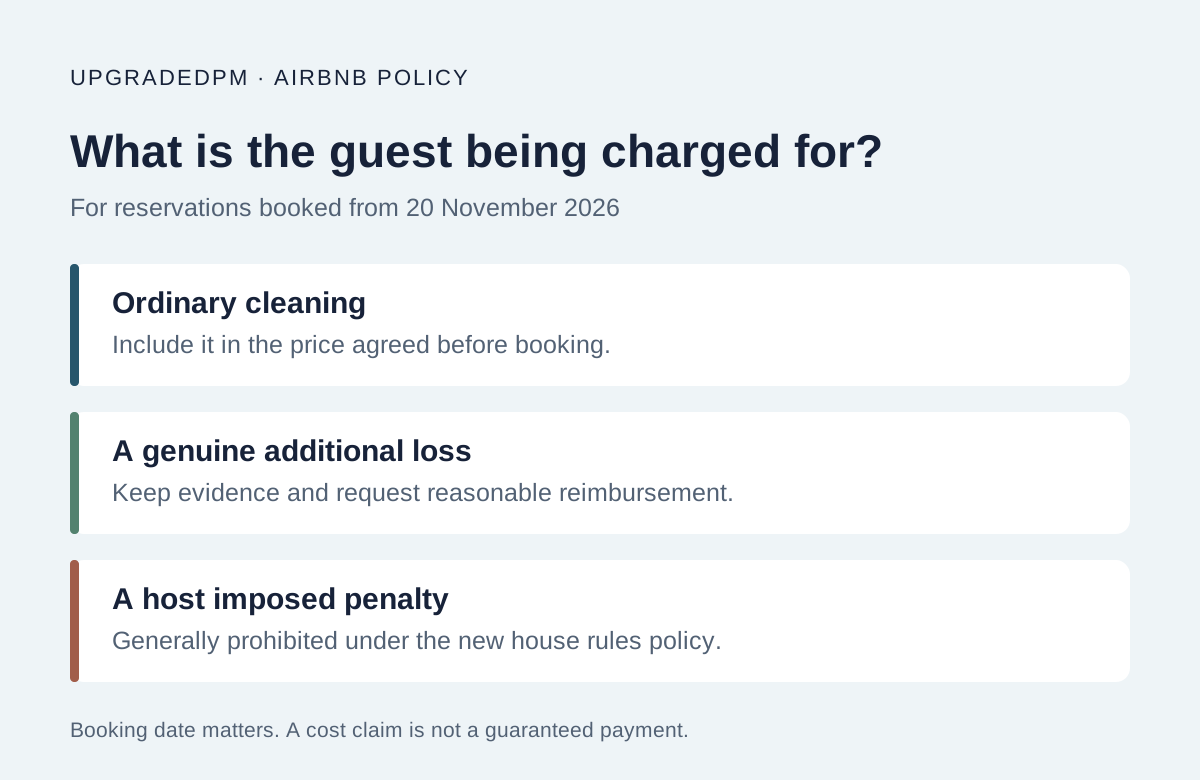
Airbnb is drawing a clearer line between a bill for a real cost and a penalty written into house rules. The new policy applies to reservations booked from 20 November. It also limits checkout chores, but does not remove ordinary cleaning fees or the guest’s responsibility for damage.
20 October 2026
Announcement published
Airbnb announced its revised approach to house rules.
20 November 2026
Booking date boundary
The policy applies to reservations booked on or after this date.
A booking date matters more than an arrival date
Airbnb’s 20 October announcement introduces a revised approach to house rules. Its Reasonable house rules policy applies to reservations booked on or after 20 November 2026. This is an Airbnb policy change, not a new UK law.
For example, a reservation made on 19 November for a December arrival falls before that policy’s stated booking boundary. A reservation made on 21 November falls after it. Record the booking date and the terms accepted for the actual reservation rather than applying a new instruction to every guest arriving after 20 November.
A penalty and a genuine cost claim are different
The new policy generally prohibits hosts from imposing their own fines or other penalties. A fixed amount written beside a house rule should not be treated as an automatically recoverable charge. Renaming a penalty an administration fee does not establish that Airbnb will accept it.
That is different from a guest causing a real loss. Airbnb’s guest ground rules still expect reasonable reimbursement where guests are responsible for damage, missing items or unexpected cleaning costs. A reasonable request needs an explanation of what happened and what it cost. Acceptance and recovery remain subject to the applicable process and evidence.
Suppose a rule says a guest owes £200 whenever smoking is detected. That is a preset penalty. Separately, if smoking causes an additional specialist cleaning bill, the actual invoice and evidence of the incident may support a cost claim. The second example is not a promise that a claim will be paid, and it does not justify billing both amounts for the same loss.
The ordinary cleaning fee still pays for the turnover
The announcement does not abolish cleaning fees. A normal fee for preparing the home between stays belongs in the price agreed before booking. Airbnb’s pricing and payment policy requires mandatory fees to be disclosed in the appropriate field, or included in the nightly price when no suitable field exists.
An unexpected cleaning cost is not a second invoice for the routine clean already priced into the stay. Airbnb’s guest ground rules already say hosts cannot charge a fee simply because a particular cleaning or checkout task was missed. Our cleaning fee guide and calculator explains how to cost the work and compare the whole guest price.
Leave the cleaner’s work with the cleaner
Under the new policy, hosts generally cannot ask guests to do substantial tasks that a cleaner would normally handle. Airbnb’s examples include stripping beds, washing and putting away dishes, and taking rubbish away from the property. Its announcement allows lighter requests such as putting used dishes in the sink, gathering used towels and separating rubbish into designated indoor bins. Airbnb says it considers the home and local circumstances when assessing exceptions.
Airbnb now says guests are expected to comply with the listing’s house rules. Additional rules still need to be reasonable and disclosed before booking. A short departure message can remind guests of what they already accepted; it should not introduce a new chore or a charge that only appears after booking.
An actual local fine has its own evidence
A fine imposed by a local government or a community association is a separate situation from a host inventing a penalty. Airbnb’s local rules guidance explains advance disclosure and requesting reimbursement through its Resolution Centre. It also says Airbnb does not collect or enforce those fines for hosts.
Keep the original notice, who issued it, the amount and the evidence linking it to the guest’s actions. Do not substitute a warning sign or your own fee schedule for an actual notice. Whether money can ultimately be recovered still depends on the facts and applicable terms.
What Airbnb clarified on 3 November
Airbnb’s clarification, updated on 3 November, says the app’s Requests label will become Additional rules over the coming weeks. Its initial listing reviews are planned from 20 November 2026 through March 2027. This is an announced rollout, so the label may not change in every account at once.
If an additional rule does not meet the policy, Airbnb says it will contact the host by email and in the app, with at least 20 days to update it or appeal. An appeal can be submitted only once, so gather supporting information first. The policy’s separate booking boundary remains 20 November: it applies to reservations booked on or after that date.
Review the guest information before the new booking date
Read the house rules alongside the departure message, welcome information and any notices in the home. Remove conflicting expectations and separate ordinary cleaning, optional services, actual damage and third party fines. The policy requires house rules to be visible in the designated listing section when a guest books, rather than introduced later in a message or a sign.
If a manager publishes the listing through a property management system, ask them to make the authorised changes there and confirm the result guests actually see. Keep the accepted information for existing reservations. Review turnover staffing and prices if cleaners were relying on guests to do part of the job.
When something goes wrong, document the condition, the work needed and any additional cost before deciding what to request. Our guest damage claims guide covers the practical judgement behind that decision. The useful response to this update is clearer guest information and properly priced operations, not a longer list of automatic charges.