
UK · Rental and holiday let owners
Bank Rate rises to 4%: what landlords should check
The Bank of England increased Bank Rate from 3.75% to 4% on 5 November. For a property owner, the immediate question is how the loan works. A tracker, a fixed deal and a lender’s variable rate can respond differently. Start with the contract, then work through what a changed payment would leave each month.
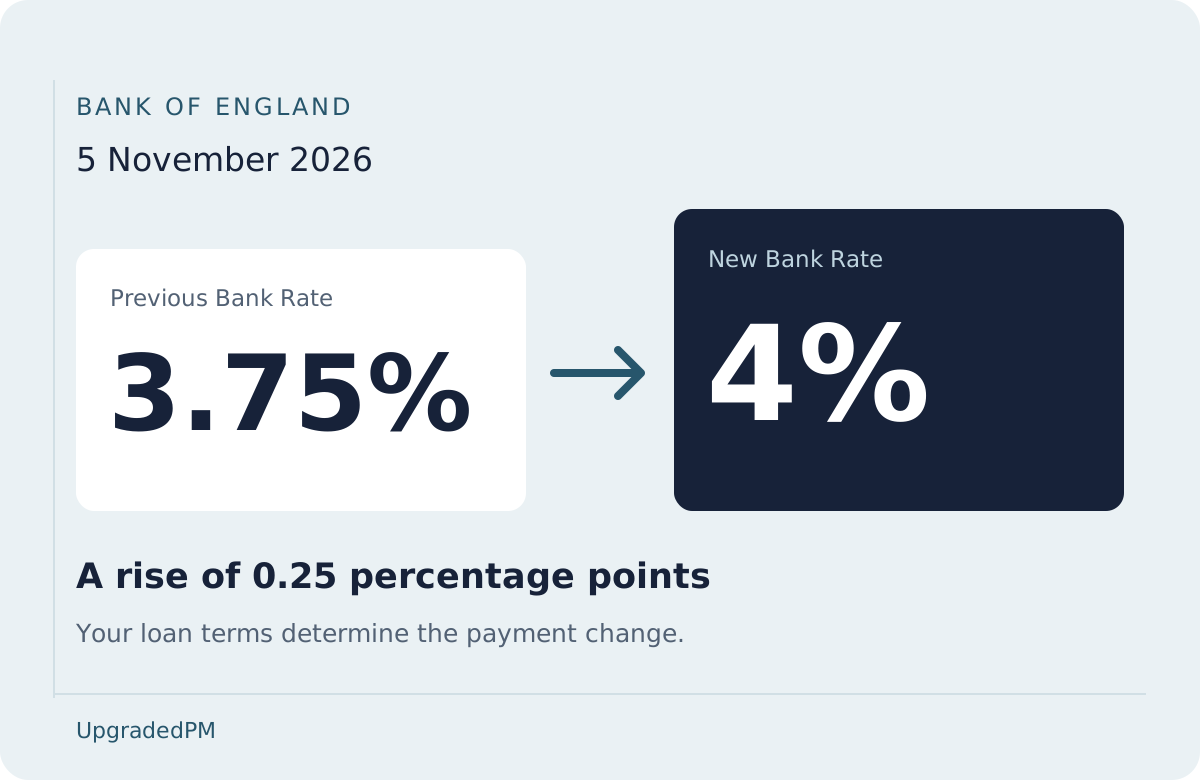
5 November 2026
Decision published
Bank Rate increased by 0.25 percentage points to 4%.
Your lender’s date
Any payment change
Check the contract and the lender’s notice for the rate and payment that apply to your loan.
17 December 2026
Next scheduled decision
The next meeting date gives no guarantee about the direction of rates.
Try your loan figures
Compare two loan rates with the same balance and term. The default rates are illustrative. Your lender confirms the actual rate, start date and payment.
Monthly illustration with no fees, tax, overpayments or rate changes during the period. Repayment figures use equal monthly payments across the remaining term. An interest only payment leaves the capital outstanding.
A Bank Rate tracker
Read the agreed margin, any floor and the date the lender applies a change. A 0.25 percentage point increase reaches the payment only as the contract provides.
A fixed deal
The agreed rate stays fixed during the deal. Use the end date to plan the next payment and compare actual offers for that point.
A lender’s variable rate
The lender sets its variable rate. Check its notice for the actual change and effective date before updating the property budget.
What changed on 5 November?
The November Monetary Policy Summary and Minutes confirm a rise of 0.25 percentage points to 4%. Eight committee members supported that increase. The remaining member preferred a larger rise to 4.25%. The meeting ended on 4 November and the decision was published the following day.
The Bank points to stronger inflationary pressures, particularly from higher energy prices. It also says future decisions will depend on the evidence. Treat the next scheduled decision on 17 December as a date to review the position, rather than a promise of a rise or a cut.
Find the part of your loan that can change
The FCA’s explanation of mortgage rate changes distinguishes trackers, lender variable rates and fixed deals. A Bank Rate tracker follows its agreed reference rate and margin, subject to the contract. Check when the lender applies the change and whether the loan has a floor or other condition.
A fixed rate stays fixed for its agreed period. The useful date is when that deal ends. For a lender’s standard variable rate or a discount linked to it, read the lender’s actual decision. NatWest’s explanation makes clear that a lender does not have to pass on a Bank Rate change to its standard variable rate.
Keep the current statement, deal end date and any new payment notice together. If the property is financed through more than one loan or mortgage part, check each separately. A single blended rate can hide a fixed part that is unaffected and a variable part that changes sooner.
What does a quarter point mean in pounds?
For an unchanged £200,000 balance on interest only terms, an increase in the loan rate from 5.50% to 5.75% adds about £41.67 a month, or £500 over a full year. That example assumes the whole 0.25 percentage point change reaches the loan and stays there. The starting rates are illustrative.
The same increase costs about £20.83 a month for each £100,000 of an unchanged interest only balance. A repayment loan needs a different calculation because the payment also reduces the debt. Use the illustration above to compare both approaches with your own balance and remaining term.
The figures exclude fees, insurance, tax, overpayments and changes during the year. Actual lender calculations can use different interest and rounding conventions. Use the lender’s confirmed payment in the property budget when it arrives. The illustration helps frame that conversation; it does not select a mortgage for you.
Compare the full cost when a deal is ending
Ask the lender or an appropriately qualified mortgage adviser for the options available for the actual property and borrowing. Compare the payment, product fee, legal or valuation costs, early repayment charge and the time you expect to keep the loan. A lower headline rate can still cost more over that period.
Check that the finance permits the way the home is being used. A tenancy and a holiday letting operation can have different lending conditions. Do not assume an ordinary residential mortgage permits paying guests because the monthly payment looks affordable.
If a payment is becoming difficult, contact the lender early. The FCA’s guidance encourages that conversation before payments are missed. The options depend on the loan and circumstances, so avoid treating a consumer support example as a guaranteed concession on a business mortgage.
Put the new payment beside the property’s real income
For a tenancy, use the rent actually being collected and allow for repairs, management and empty periods. A financing increase does not tell you what a tenant can afford or what the home will achieve in the local market. The Bristol rental market report provides the local rent evidence, with its measurement dates kept visible.
For a holiday let, test a quieter month as well as the annual average. Keep cleaning, utilities, platform costs and maintenance alongside finance. The winter short let income guide helps work through that operating budget. An extra booking is useful only if its contribution covers the work and costs it creates.
If the question is the day to day running of your rental, talk to UpgradedPM about the property. Bring the actual income and operating costs. Your lender or mortgage adviser remains the right person to assess the borrowing options.