
Edinburgh · Paid visitor accommodation
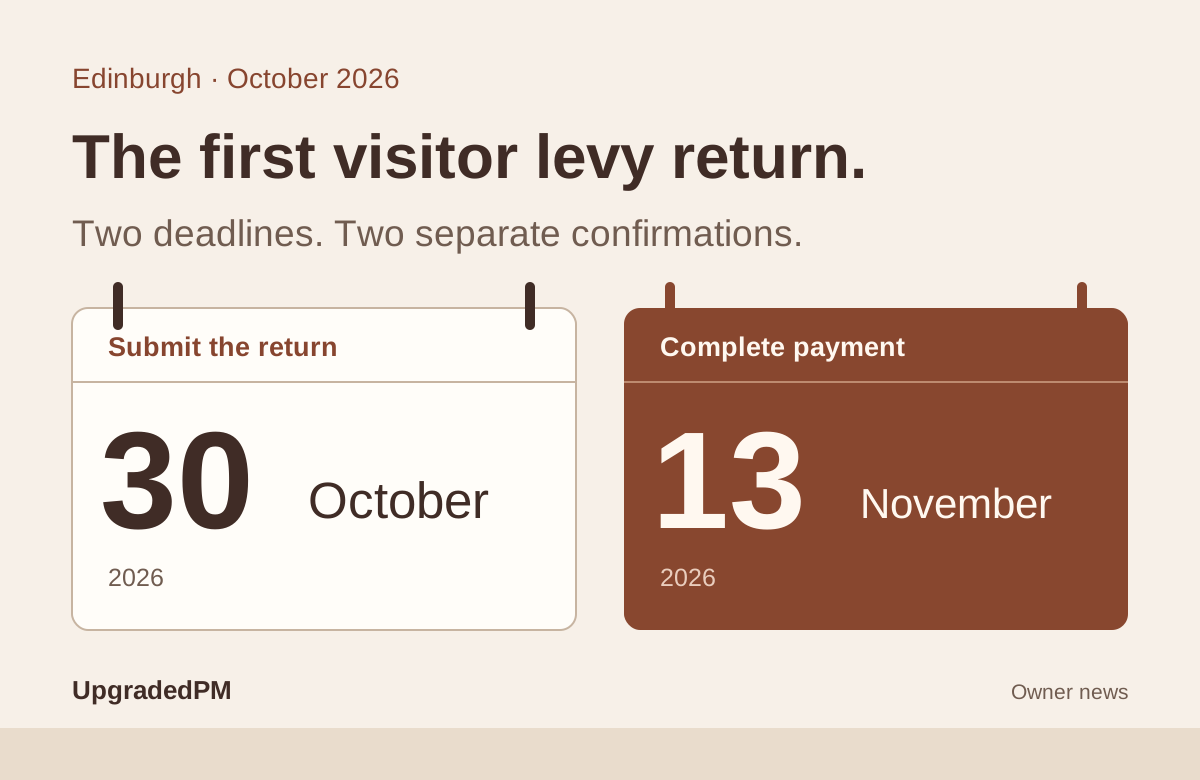
Edinburgh’s first visitor levy return is due on 30 October. Payment has a different deadline.
The first reporting period has ended. Hosts need to reconcile qualifying stays, submit the return and arrange payment, rather than assume a booking platform has done all three.
24 July 2026
First reporting period began
The first period covers eligible stays from this date to 30 September, using the council’s checkout rule.
30 October 2026
Return deadline
The current council guide gives 1 to 30 October as the first submission window.
13 November 2026
Payment deadline
The first payment window runs from 1 October to 13 November. Filing alone is not payment.
Illustrative calculation
Seven nights booked.
Five nights charged.
A provider who is not VAT registered. Accommodation at £120 per night, no extras and no exemption. The levy shown is before administration retention.
Accommodation total
Accommodation within cap
Visitor levy at 5%
This is not a return or a VAT invoice. Different nightly prices need a calculation using the actual relevant nights.
Use the current deadline, not an old launch document
Edinburgh accommodation providers are approaching their first visitor levy return deadline. The council’s current provider guide, version 2.1, gives 30 October 2026 for submission and 13 November 2026 for payment. The first period runs from 24 July to 30 September. Page 13 sets out the two separate windows.
This is worth checking even if your levy settings were switched on for launch. Collecting a guest charge, recording it in a booking system and sending a return are different tasks. Establish who is preparing the figures, who will submit them and who will authorise the payment. Keep the confirmations together, but do not mistake one for the other.
Start with completed stays and the booking history
The levy applies to eligible stays beginning on or after 24 July 2026. The booking transition protects qualifying bookings made and paid in part or in full before 1 October 2025. The current provider guide requires specific dates, room count and nightly prices, with a tangible, attributable, non refundable payment. A refundable deposit alone is not enough. Retain the original terms, payment evidence and amendment history, and check the treatment if the booking changes.
The reporting quarter follows checkout where a stay crosses a quarter boundary. That makes the actual departure record important. A bank settlement in October does not by itself put a September checkout into the next reporting period. Reconcile reservations with stays that actually happened, rather than treating every reservation created during the quarter as a completed visit.
Five per cent does not always mean five per cent of the whole booking
Edinburgh’s scheme charges 5% of the accommodation cost excluding VAT, limited to the first five consecutive nights of a chargeable transaction. It is not a charge per guest. The five night cap makes a difference for longer visits, but it does not make the stay exempt.
The example above assumes a provider who is not VAT registered, seven nights at £120 accommodation per night, no extras and no exemption. Accommodation totals £840. The first five nights cost £600, so the levy is £30 before any administration retention. Charging 5% on all seven nights would produce £42 instead. These are illustrative figures, not a return or a VAT invoice.
Reconcile the accommodation price, not just the payout
A booking platform’s bank payout is a poor starting point if it combines accommodation, commission, refunds and other adjustments. Keep the guest’s booking breakdown beside the settlement record. If nightly prices differ, identify the relevant first five nights rather than assume an average across the entire stay will give the right result.
Do not automatically remove a charge from the levy base because it appears on a separate line. The council guide explains accommodation charges and different selling arrangements. Read the treatment that matches your actual contract. If your software produces one unexplained total, ask for the underlying calculation before relying on it for the return.
VAT status and exemptions need their own evidence
The non VAT example cannot be copied straight into a VAT registered business’s invoice. Check the treatment of both the accommodation and the levy with your accountant using the current VisitScotland guidance and linked FAQs. The levy calculation is based on accommodation excluding VAT, but that does not settle every VAT consequence of collecting it.
For eligible individual exemptions, the council guide says the guest still pays upfront and claims reimbursement from the council. Follow that process rather than simply omit a charge. Avoid collecting unnecessary sensitive documents. Cancelled stays also need attention: VisitScotland says the levy should be refunded where the stay does not happen, even if the accommodation itself was sold on a non refundable basis.
Do not assume the platform sends the council your money
The council directs providers to visitorlevy.scot for reporting and payment. Its business guidance explains that this service handles the provider’s return and payment to the authority. It is not the system used to charge a guest at booking or checkout.
If an agent or booking platform is involved, establish the arrangement that actually applies. A line on a guest receipt is not evidence that a return has reached the council. VisitScotland distinguishes distribution partners with an agreed direct payment arrangement. Ask for the relevant agreement and the return or payment reference, not a general assurance that tourist taxes are automated.
The 2% administration allowance is not 2% of booking revenue
Edinburgh allows providers to retain 2% of the levy to help with administration costs. The provider guide says visitorlevy.scot calculates this retention. It does not reduce the guest levy rate from 5% to 3%, and it is not an allowance equal to 2% of the accommodation price.
Keep the levy collected, the platform’s retention calculation and the amount payable as separate figures. That makes a mismatch visible before money leaves the account. If several properties share one bookkeeping process, preserve enough detail to explain each property’s contribution to the return. An accurate total is useful only when you can reconstruct how it was reached.
Keep a return record that another person can follow
The downloadable record provides space for the period, property, booking references, calculation and the person responsible for filing. It also separates submission evidence from payment evidence. Use internal booking references rather than copying passports, full card details or unrelated guest information into a shared document.
Save the original booking export before changing it. Record any adjustment with its reason, so someone reviewing the figures later can distinguish a cancellation from a correction. When the return is submitted, save its confirmation and final figures. When payment is made, match the amount and reference to that return and retain the payment confirmation separately.
Resolve an uncertain calculation before filing day
If an agent, accountant or software supplier cannot explain a figure, raise the exact discrepancy now. Send the booking reference, the relevant dates and the calculation you expected, with unnecessary personal details removed. A specific question about a seven night booking is easier to resolve than an unexplained difference in the quarter’s total.
Check the council’s current instructions again when preparing the return, particularly if you have complex packages, amendments or exemption claims. This article reflects guidance checked on 15 October 2026 and is not personalised tax advice. Edinburgh’s timetable and rate should not be applied to another Scottish council area. The practical task here is to file the correct Edinburgh return by 30 October and complete payment by 13 November.
Who keeps the property records?
Tell us about the property and the work you need help with. We can explain what a management agreement would cover and what stays with you or your adviser.