
Wales · Holiday let owners
Wales 182 day rule consultation has closed
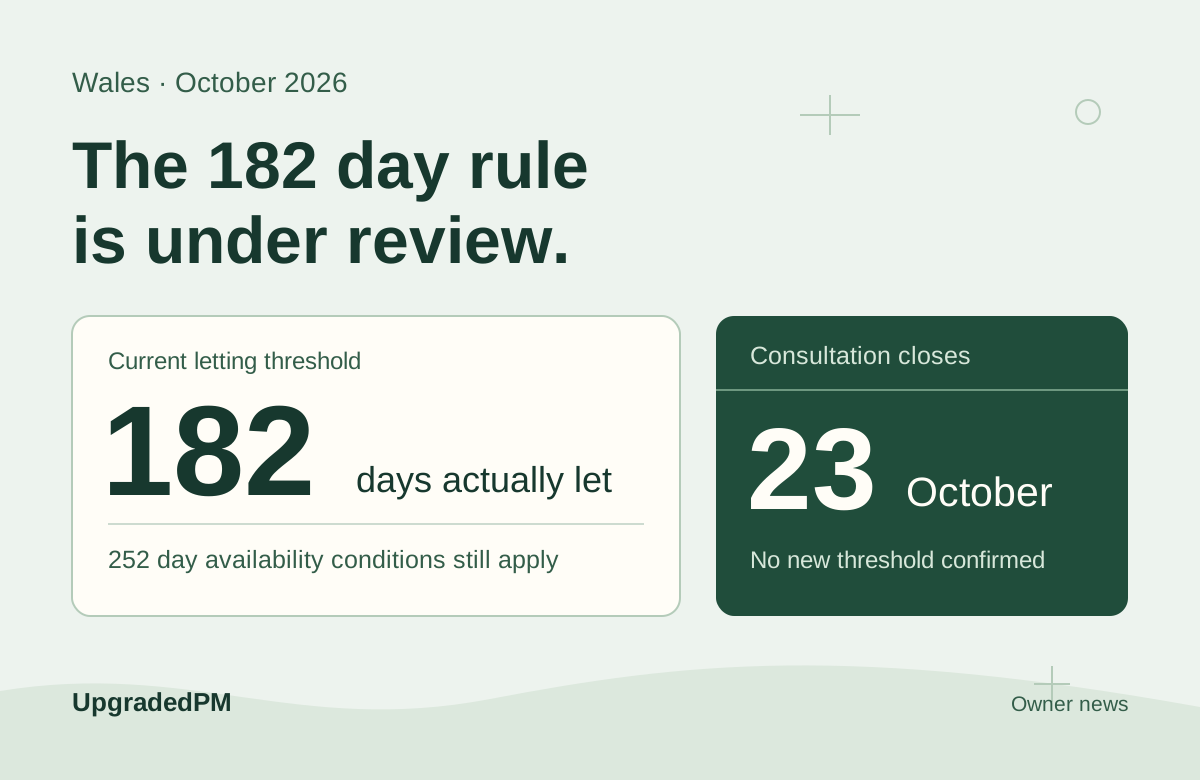
The consultation closed at 11:59pm on 30 October. The Welsh Government is reviewing responses and will publish an outcome. The current 182 and 252 day tax conditions still apply.
30 October 2026
Consultation closed
The extended response period ended at 11:59pm. The government is now reviewing responses.
End of 2026
Review intended to finish
The government intends to complete its review of the letting threshold this year.
1 April 2027
Conditional start date
Any adopted changes would need legislation. This is the intended date, not a change already in force.
Proposed, not in force
Would the property fit a proposed exemption?
Open a category to see the boundary. These proposals concern historic letting tests. Genuine self catering use and 252 days of intended commercial availability would still be required.
Read the full proposalsResponses are now being reviewed
Updated 31 October 2026. The Welsh Government’s consultation on local tax classification closed on 30 October 2026. Its current page says responses are being reviewed and an outcome will be published when that work is complete.
The response window was extended to 11:59pm on 30 October after the consultation closed at 5pm on 23 October, earlier than the advertised 11:59pm deadline. That extension did not change the current classification rules or introduce an exemption.
The review concerns whether the 182 day letting threshold should change and which properties could be exempt from the historic letting tests. Closure is not a decision to adopt those proposals.
The current 182 and 252 day conditions still apply
The current Business Wales guidance requires commercial availability for at least 252 days in the preceding twelve months and an intention to offer at least 252 days in the following twelve months. The ratepayer must have an interest that permits that letting. Actual commercial letting must meet the 182 day test, including any applicable averaging provisions.
A property does not qualify for business rates simply because an advert calls it a holiday cottage. Keep the available dates separate from nights actually let. Owner visits, blocked maintenance dates and cancelled stays can make an apparently busy calendar very different from the record needed for classification. Our Welsh holiday let rules guide explains the wider position.
Some flexibility already exists
Changes effective from 1 April 2026 allow the actual letting threshold to be met using an average across the previous two or three years, subject to the rules. A separate allowance can count up to fourteen days of donated short breaks each year, provided through a registered charity for its beneficiaries. These are existing provisions, not promises made by this consultation.
Do not treat every free stay as a charitable donation or assume averaging removes the availability requirement. If you rely on either provision, retain the underlying dates and supporting documents. A single annual occupancy percentage cannot explain which nights qualify or why the calculation is valid.
Five possible exemptions need careful reading
The government’s announcement identifies accommodation integral to a wider business, large combined properties, relevant planning restrictions, accommodation within the owner’s home curtilage and accommodation on the owner’s farm. These are proposed categories, not a general exemption for cottages or rural properties.
The proposal explorer above explains the important boundaries. The detailed wording matters more than the category name. A separate investment house is not automatically part of the owner’s home, and owning several cottages is not the same as one combined assessment. The proposals would still require genuine self catering use and at least 252 days of intended commercial availability in the year ahead.
There is no confirmed replacement number
The consultation asked about the effects of reducing the threshold. It did not announce a new threshold that owners can start using. In the full proposals, 154 days appears as an illustration in the discussion of how far a reduction might go. It is not a settled replacement for 182.
If you responded, keep the figures and explanation you sent alongside the property’s actual letting record and costs. Compare any eventual change with that evidence before revising your plans. Do not assume a lower tax bill from a proposal that has not become law.
Show what happened at the property
Start with the period your figures cover. Reconcile the booking export with the actual stay record and the dates the property was offered commercially. Explain gaps rather than removing them. A cancelled reservation, a repair closure and a week reserved for family use tell different stories, even when all three leave the calendar empty.
Keep actual bills and costs with their dates, distinguishing turnover from profit and a rateable value from a rates bill. Store forecasts separately with their assumptions so that a later policy change can be assessed against what the business has actually done.
A proposed exception needs property evidence too
Where a proposal could apply, identify the document that supports the connection. That might be the relevant planning decision, title plan, rating assessment or records showing how accommodation forms part of another business. Describe what the document establishes. A photograph of a rural setting cannot demonstrate a planning restriction or a shared registered title.
Use the downloadable evidence record to keep the dates, figures and supporting documents together. It does not submit a response or establish eligibility for an exemption. Keep unrelated personal guest details out of the material you share.
Keep a clear record of any response
Keep the final version of any response you submitted, its supporting documents and any confirmation. Where an owner and agent were both involved, record who submitted it and which property the evidence describes.
The Welsh Government said responses emailed after 5pm on 23 October would be included in the analysis following the early closure. That statement does not extend the now closed response period.
The current consultation page records the 30 October closure and will carry the outcome. Neither an evidence record nor a submitted response changes the property’s tax classification or secures an exemption.
Do not budget on an exemption that has not been enacted
The government intends to finish the threshold review by the end of 2026. Its announcement says changes would require legislation, with an intended commencement of 1 April 2027, subject to the consultation and review. There is no guarantee that every proposal will proceed or that the final wording will match the consultation.
Meanwhile, continue using the current rules for your property. This consultation does not settle planning permission, visitor levy liability or Welsh visitor accommodation registration. Those are separate processes. If classification or a bill is disputed today, take that issue through the appropriate valuation or council route rather than wait for the consultation result.
Who keeps the property records?
Tell us about the property and the work you need help with. We can explain what a management agreement would cover and what stays with you or your adviser.