
Wales · Holiday lets and visitor accommodation
Welsh visitor accommodation registration is open: what owners need to do
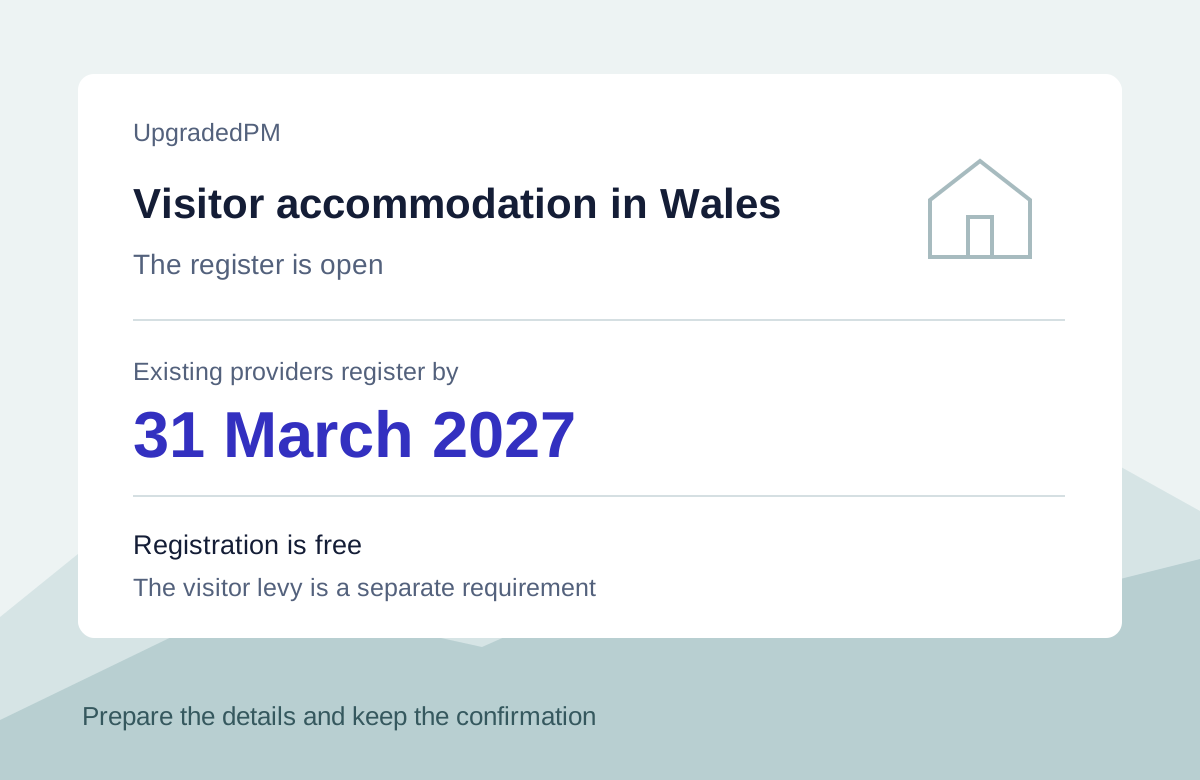
Registration is now open and free. Welsh accommodation providers must register by 31 March 2027 even where their council does not introduce Visitor Levy. Cardiff owners also need to check bookings being taken now for stays from April.
28 September 2026
Cardiff booking records
Qualifying new bookings and changes for stays from 1 April 2027 fall within the Cardiff levy rules from this booking date.
31 March 2027
Wales registration deadline
The free national register applies independently of whether a council introduces Visitor Levy.
1 April 2027
Cardiff levy starts
This is Cardiff’s start date, not a single levy start date for all of Wales.
There is now a live service to use
The Welsh Revenue Authority has opened visitor accommodation registration. Its guidance updated on 8 October 2026 confirms that providers must register by 31 March 2027. Registration is free and applies even if the local council does not introduce Visitor Levy.
This is no longer just a date to put in a business plan. Start from the official registration page, which links to the service and explains the GOV.UK One Login sign in. Keep the completed registration with the property records so the next person handling the account does not have to guess whether it was submitted.
The important distinction is between being on the register and paying a levy. They are separate obligations. An owner outside Cardiff should not assume that the absence of a local levy removes the registration requirement. A Cardiff owner should not assume that registration alone deals with the levy on future stays.
Occasional hosts can be included too
The requirement covers providers responsible for accommodation in Wales who take bookings for stays of 31 nights or less. It can include a whole holiday home, a spare room or a seasonal business. Letting only occasionally does not by itself take the provider outside the rules.
Responsibility stays with the accommodation provider. A management company can register on the provider’s behalf. If the same people or organisations are responsible for several premises, WRA guidance says to include those premises in one registration. Where responsibility differs, separate registrations are needed.
Resolve that identity before filling in the form. A property’s advertising name is not necessarily the name of the person or company responsible for it. If a couple owns one cottage together but one partner separately operates another, do not assume the arrangement should be entered as one business simply because the same agent manages both. Check the WRA guidance for the actual structure.
Start with the provider, not the listing title
The service asks for different details depending on the provider type. For an individual, have accurate personal and contact information ready. For a company or limited liability partnership, start with the company number and the relevant contact details. A trading name can be recorded separately. WRA has specific instructions for each provider type, including shared responsibility and partnerships.
Use the editable registration preparation sheet to bring those details together. It is for preparation, not a registration submission. Only the official service produces the WRA confirmation and registration number.
If an agent is helping, agree who will check the information before it is submitted and who will retain the confirmation. Share the details through a suitable private route. Avoid sending identity information to a general group conversation or copying it into a public listing description.
Check names against the records you already use for the business. Resolve a mismatch rather than creating a convenient new identity for the form. Where the responsible provider is genuinely unclear, ask the WRA for help before submission. An assumption made now can complicate a later sale or change of management.
Count what guests can actually book
For each premises, prepare the address and name. The service then asks about the accommodation type, when it is open, the number of accommodation units and the maximum number of guests. WRA’s accommodation guidance explains that a unit may be a cottage, room, pitch or bed, depending on the operation.
Do not copy the bedroom count into a field asking for bookable units. A whole cottage advertised as one stay is a different arrangement from rooms sold individually. Use the guidance that fits the accommodation actually being offered and check a mixed site carefully.
Compare the information with the live adverts before submission. If a listing says it sleeps six but the agreed safe guest capacity is four, resolve that difference rather than choosing whichever number is easiest. The registration should describe the actual operation, not a marketing ambition.
Keep a short record of who checked the figures and when. This is especially useful where several people maintain the booking platforms. If a sofa bed is removed or a unit stops trading, there should be an obvious person responsible for changing the adverts and reviewing the registration details.
Keep the confirmation and check the public entry
The WRA sends a confirmation email or letter with the registration number after completion. Keep it with the provider and premises records rather than leaving it only in the inbox of the person who submitted the form.
Some information appears on the public register, including accommodation details and relevant business names and addresses. Individual providers’ names and home addresses are not published by default, although exceptions can apply where those details are also used for the business. Date of birth, telephone number and email address are not displayed. Read the public register guidance to check how your own entry will appear.
Check the public entry against what you submitted. If something is wrong, retain the confirmation and use the WRA’s support route. Do not create a second registration merely to try to correct the first one. Keep a note of the issue and the response so another person does not repeat the request.
Make changes someone’s responsibility
The WRA’s technical guidance requires changes to be notified within 30 days. Its current service notice also says update features will be available early next year and existing details must be brought up to date by 31 March 2027. If a change happens before those features are available, check the current guidance and contact the WRA for the correct route.
Keep the confirmation somewhere the business can still access if the agent, employee or accountant changes. Put a review of the registration into a sale or management handover rather than leaving it to the new operator to discover later.
For an owner with several properties, record the registration number against the right provider and premises. A shared folder called “Wales registration” becomes confusing quickly if it contains several businesses. Clear names and a single current record are more useful than duplicate scans with no explanation.
Cardiff’s levy affects some bookings being made now
Cardiff’s Visitor Levy starts on 1 April 2027. WRA guidance says qualifying bookings made from 28 September 2026 for stays from that start date fall within the levy rules. Changes can also matter, including added nights or guests. The official booking examples explain how an existing reservation can be affected.
Illustrative example: a guest makes a new Cardiff booking in October 2026 for a stay in May 2027. The booking date and the stay date are both relevant. Moving the money through a booking platform does not by itself explain how the provider will account for the levy.
Retain the original booking date, stay dates, guest details needed for the levy calculation and any later changes. Do not overwrite the original reservation record when the stay is amended. The change history may explain why additional nights or guests need different treatment.
Before changing prices or guest messages, read the current WRA guidance on rates, exemptions, refunds and payment. This article does not assume that a platform will collect the levy for you or that every stay is chargeable. Check the current council position for the property rather than applying Cardiff’s dates across Wales.
Registration does not settle the other property checks
A WRA registration number is not planning permission, proof of business rates eligibility or permission from a lender or freeholder. Keep those checks separate. The Welsh holiday let rules guide covers the broader buying and operating questions; this update concerns the registration service and immediate preparation. The separate 182 day rule consultation does not alter the registration deadline.
England has a different timetable. Its guidance updated on 2 October 2026 says the national holiday let register is expected to begin in March 2027 and is not yet in force. Do not use that expected date to postpone a Welsh registration.
If you want help organising the operation of a Welsh holiday property, speak to UpgradedPM about the property and the work involved. Management can help keep records and responsibilities clear. It does not replace the provider’s obligation to register or guarantee a planning or tax outcome.
Need help looking after your property?
Tell us where your property is and how you let it. We can explain the management service and the information we would help you keep.