
England · Private residential landlords
Awaab’s Law for private landlords: what the October consultation changes
The government opened its consultation on 9 October. Private landlords do not yet have the proposed fixed repair deadlines, but a damp report still needs a proper response today. Here is what to prepare and what to record.
9 October 2026
Consultation opened
Government is seeking views on applying Awaab’s Law to private rented homes in England.
30 November 2026
Separate social housing change
The planned expansion for social housing is not the start date for private landlord repair deadlines.
18 December 2026
Consultation closes
Responses must reach the government by 11.59pm. The private sector implementation timetable remains under consultation.
What has actually happened?
A new government consultation is asking how Awaab’s Law should work for private rented homes in England. It also considers certain accommodation occupied under licence. This is a consultation on the detail, not an announcement that the social housing rules now apply to every landlord.
The proposals concern the hazards covered, investigations, remedial work and the time allowed for action. Further regulations are needed before the new private sector requirements take effect. The full consultation sets out those questions and the closing date.
For an owner with a few rental homes, the useful preparation is practical. Can a tenant reach someone when a problem gets worse? Does the contractor receive the original report? Who checks that the repair worked? A new deadline will expose a weak handover very quickly, but those questions already matter to the person living in the property.
A consultation is not a reason to delay a repair
Existing repair and housing safety duties continue. Landlords are normally responsible for the structure, heating and hot water, and sanitary installations. The home must also meet applicable safety and fitness requirements. The government’s repair guidance explains the current position. A serious problem needs a response based on its actual risk, not on whether a future deadline has begun.
Do not lift a social landlord’s deadline into a private tenancy policy and call it the law. Equally, do not use the lack of a new fixed deadline to leave a tenant waiting. The reasonable time for an existing repair depends on the circumstances. Obtain property specific professional advice where the risk or the legal position is unclear.
Keep the distinction visible in any owner update. A confirmed appointment, an inspection finding and a proposed repair are different things. Saying “the contractor is dealing with it” gives neither the tenant nor the owner a useful expectation if nobody has agreed when the contractor will attend.
Give the first report to someone who can act
When a tenant reports a problem, preserve their words and record when the message arrived. Ask which room is affected, whether it is spreading and what has changed. Photographs can help arrange the right attendance, but they do not replace an inspection or justify waiting while a potentially serious problem continues.
The official damp and mould guidance calls for an urgent assessment of severity and risk. It says landlords should not wait for medical evidence before acting. Take a health concern seriously, obtain the appropriate professional help and avoid trying to diagnose the tenant or the building from a photograph.
A useful acknowledgement tells the tenant who is handling the report, what is being arranged and when they will hear again. If the appointment is not confirmed, say that plainly and set a time to update them. Agree how they can report a deterioration. Do not let a message disappear between an owner’s inbox, a contractor’s phone and an agent’s maintenance screen.
A contractor needs more than “mould in bedroom”
Send a brief that distinguishes what the tenant reported from what has been established. Include the affected location, dated photographs, any previous attendance and the access arrangements. State the question the visit needs to answer. For example, a returning patch after a roof repair calls for an investigation of the cause, not simply a quote to repaint the ceiling.
Ask the contractor to return a written finding with the work completed, anything still unresolved and the next recommended action. If another trade is needed, someone must book that trade and tell the tenant. A recommendation sitting in an attachment is not an arranged repair.
The government guidance emphasises addressing the underlying cause rather than just removing visible mould. It also recommends an inspection at least six weeks after remedial work to check the problem has not returned. That is guidance for damp and mould management, not a new private sector statutory repair deadline.
Share only information needed for safe attendance and the work. A practical access requirement may be relevant to a contractor; an entire tenant correspondence history usually is not. Keep sensitive information out of general contractor groups and shared photo folders.
Keep a record that shows what happened
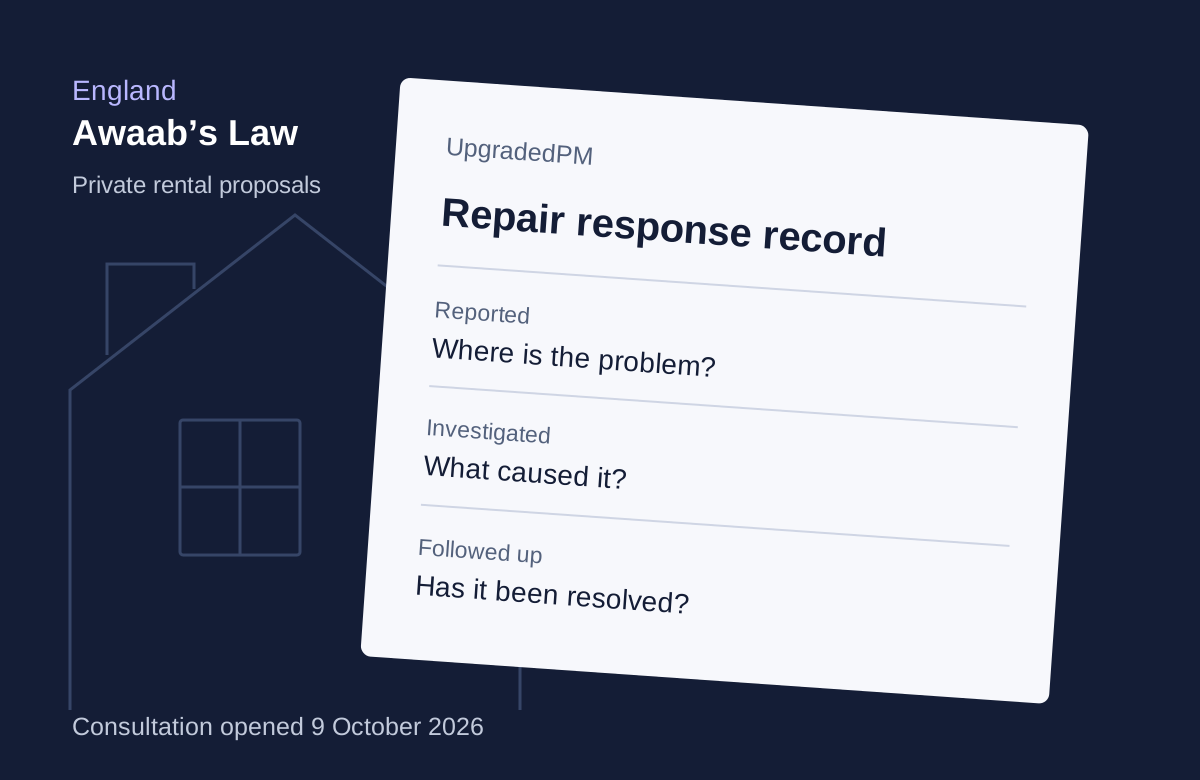
Our editable repair response record provides a place for the original report, the assessment, communications, attendance, work and the planned review. It is an operating record, not a legal certificate and not a substitute for competent advice.
Use actual dates and times. Record an appointment as proposed until it is accepted, and work as completed only when there is evidence it happened. Where access fails, keep the attempted contact and the new arrangement. A missed appointment should remain visible until someone has resolved it.
Keep a named person responsible for the next action. “Awaiting contractor” is not enough if nobody knows when they will chase. Record the date of the next update alongside the task, so a tenant does not have to start the conversation again to discover that nothing has moved.
At the end, preserve the finding, the invoice or job report and the tenant update together. A photograph of a newly painted wall does not by itself establish that a leak stopped. Record the basis for closing the case and any review still due. If a problem returns, reopen the history rather than treating it as an unrelated first report.
An example of a handover that does not lose the problem
This is an illustrative scenario, not an UpgradedPM case study. A tenant reports a damp patch beneath an upstairs window. A decorator visited earlier in the year, but the staining has returned. The manager records the new report against that earlier visit and asks a suitable contractor to investigate why the patch has come back.
The contractor finds a defect around the window and gives a repair recommendation. The manager agrees the work and access, then tells the tenant what is confirmed. When the contractor finishes, the manager requests the job report and records the work actually carried out. Decoration is arranged when appropriate rather than being mistaken for the repair itself.
The case stays open for the agreed review. If the tenant reports another wet patch before then, the manager can see the earlier finding and escalate it to the right person. There is no need to reconstruct the sequence from several phones, and the owner can see what was done rather than just a bill.
Use this autumn to test the arrangements you already have
Choose a recent repair and follow it from the tenant’s first message to the final check. Look for the point where progress depended on someone remembering to chase. If there was no confirmed attendance, no return report or no named next action, fix that part of the process now.
Agree what happens when the usual contractor cannot attend, when the owner is away and when a tenant reports something outside office hours. Make sure emergency reports reach a person able to arrange an appropriate response. A shared mailbox is not cover if nobody is responsible for reading it.
If you use a managing agent, ask how you will be told about a serious issue and how outstanding repairs are reviewed. If you manage the home yourself, decide who can cover when you cannot respond. The property CRM guide explains how to keep communications and tasks together without confusing a saved message with completed work.
What to watch after the consultation
The government will consider responses before setting out the next steps. Check the official consultation for the eventual response and commencement details rather than relying on a headline about a different housing sector. This article concerns England and should not be used as a statement of Welsh, Scottish or Northern Irish tenancy law.
If you contribute evidence, explain a practical problem and how you would address it. An anonymised account of contractor availability or an access delay is more useful than identifying a tenant. A consultation response does not resolve an individual repair dispute.
UpgradedPM can discuss the management and maintenance arrangements for your rented property. Tell us about the property and the support you need. If there is an existing urgent repair or hazard, use the appropriate emergency or professional service now rather than waiting for a management enquiry to be answered.
Need help looking after your property?
Tell us about the home and the work you need help with. We can explain how repairs, tenant communication and owner reporting would be managed.