
England, Wales and Northern Ireland · Individual landlords
Budget 2026 proposes higher tax on rental income
The Budget announced another two percentage point rise in property income tax from April 2027. That changes the forecast for next year, rather than the rates used for a return you are preparing now. Start with the owner’s taxable profit and keep the tax years separate.
28 October 2026
Budget announcement
The government announced a further rise in the proposed property income rates.
6 April 2027
Intended start
The new rates are to be legislated for in Finance Bill 2026 to 2027.
The latest announcement adds to last year’s plan
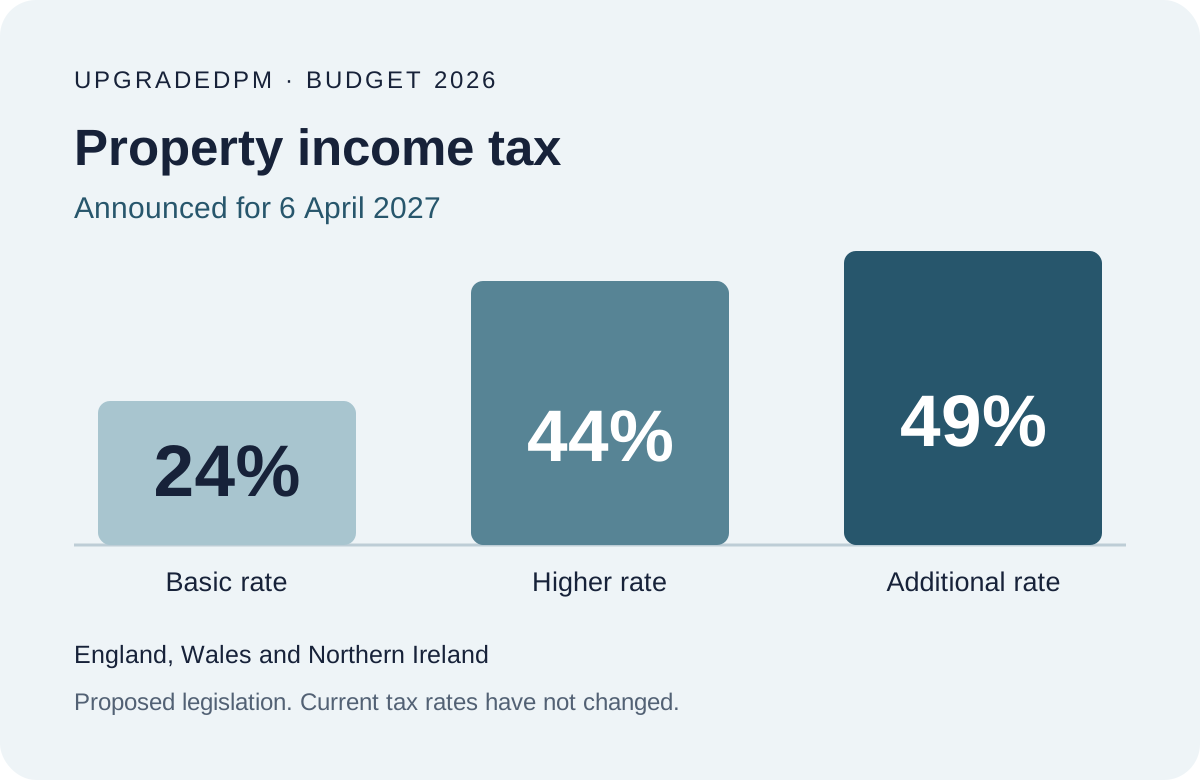
The Budget published on 28 October proposes a property basic rate of 24%, a higher rate of 44% and an additional rate of 49% from 6 April 2027. The government says it will legislate for the change in Finance Bill 2026 to 2027. These are announced future rates, not rates that took effect on Budget day.
The previous Budget had announced separate property rates of 22%, 42% and 47% for that same start date. The latest announcement adds two percentage points to that plan. Compared with the current 20%, 40% and 45% rates in England, the announced rates are four percentage points higher.
Use the date on the source as well as the number. An older article quoting 22%, 42% and 47% may be describing the earlier plan accurately, while still giving you the wrong assumption for a forecast prepared after this Budget.
Check the owner and the tax year first
HMRC’s tax legislation overview states that the announced property rates apply across England, Wales and Northern Ireland. It also explains the devolved power to set property income rates. Do not apply the figures to a Scottish taxpayer without checking the Scottish position for the relevant year. The location of a rental property alone does not settle its owner’s personal tax position.
These are Income Tax rates. A property held by a company has a Corporation Tax calculation, and taking money out of the company raises separate questions. Do not substitute these percentages for a company’s tax forecast or assume that transferring a property into a company is a simple way around the change.
For an individual, keep the 2025/26 return, the current 2026/27 year and the forecast for 2027/28 distinct. The announced start is 6 April 2027. It does not put the new percentages into the 2025/26 return due this coming January. HMRC’s current rates page sets out the current bands and explains the different Scottish rates.
What an extra two points means in a simple case
Assume an individual in England has £10,000 of taxable rental profit, all within the higher rate band. Their personal allowance is already used. There is no mortgage interest, loss, relief or other allowance interaction, and the profit and tax band stay the same in each comparison. This is a deliberately limited example, not a personal tax estimate.
At the current 40% rate, tax on that profit is £4,000. Under the earlier 42% plan it would be £4,200. At the newly announced 44% rate it would be £4,400. The latest announcement therefore adds £200 against the earlier plan, or £400 against the current rate. Those are two different comparisons.
If the owner had already budgeted for 42%, spreading the extra £200 across a twelve month forecast would mean about £16.67 more set aside each month. That is a planning illustration, not a new monthly tax payment requirement. The date a rate starts and the date a tax payment falls due are different things.
The example uses taxable profit, not gross rent or the payout from a booking platform. For a mortgaged property, the finance cost reduction and its limits need their own calculation. Do not multiply gross booking income by two per cent and call the result your additional tax bill.
Holiday let owners need the same date discipline
The special Furnished Holiday Lettings tax regime ended in April 2025. The Budget announcement does not restore it. Our holiday let tax guide explains the existing ownership, mortgage interest and loss questions. Keep those questions in the calculation when updating a forecast for the announced rates.
A nightly price, gross booking total and taxable profit measure different things. Reconcile receipts, refunds, platform charges and allowable expenses for the correct tax year before asking your accountant to model the change. A calendar year platform summary will not necessarily match an individual’s April to April tax year.
Keep a current year forecast and a separate April 2027 forecast using the same operating assumptions. That makes it possible to see the effect of the announced tax change rather than mixing it with a hoped for occupancy increase or a new nightly rate.
Put the revised tax beside the actual operating return
Use the blank forecast note to record the owner, tax year, profit assumption and the source date for the rates. Ask your accountant to replace the simple example with the complete calculation, including other income, finance costs, losses and any allowance restrictions. Keep the payment timetable with that calculation.
Then compare the cash left after genuine running costs, finance payments and tax. If you are considering a different letting model, carry its additional costs and permissions into the comparison. A higher gross rent is not proof that the owner will keep more.
We can help organise the property’s operating forecast and management records for that discussion. Tax advice should come from the adviser who can see the owner’s full position. As the Finance Bill progresses, check the final legislation before treating an announced rate as the rule that applies to a particular return.