
England · Owners of empty homes
Empty home orders in England: what changed on 5 November
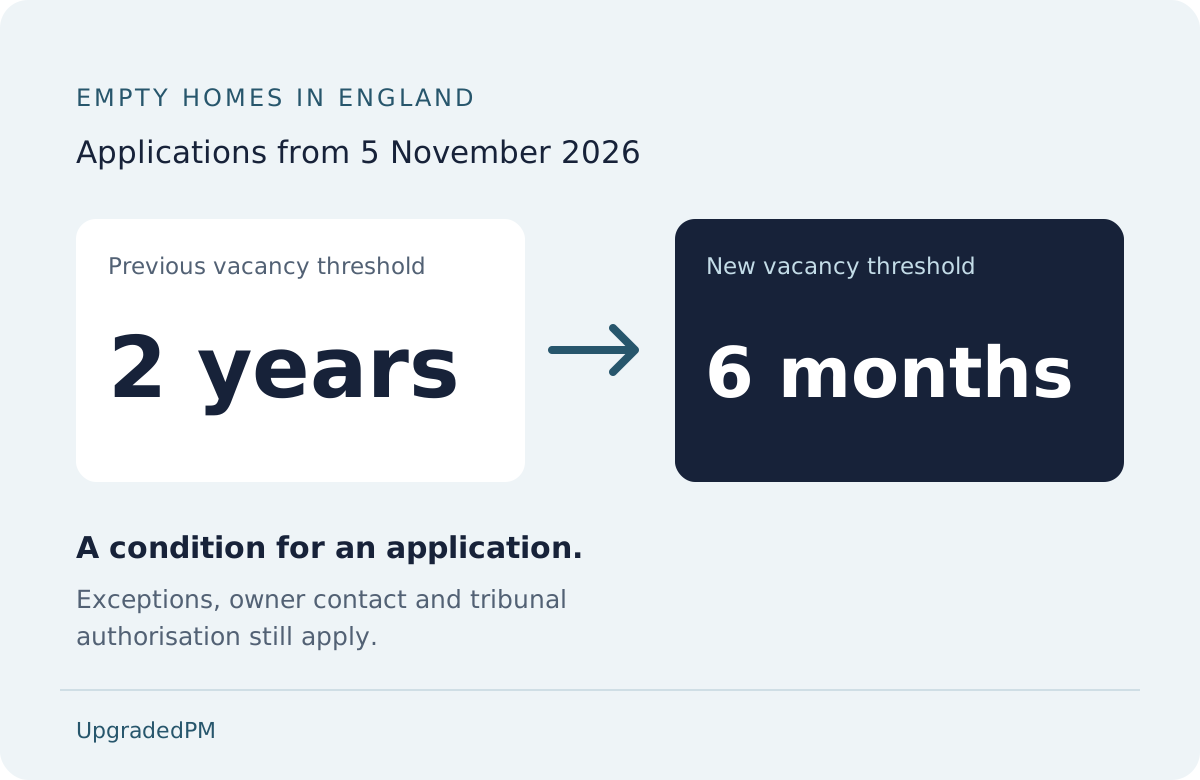
Councils in England can apply sooner for an empty dwelling management order (EDMO) following a change that took effect on 5 November 2026. Six months of vacancy is one condition for an application. Exceptions, contact with the owner and a separate tribunal decision still matter. Here is what changed and how to keep a useful record if a council gets in touch.
14 October 2026
Order made
The amendment was made and laid before Parliament.
5 November 2026
New application rules
The changes apply to applications submitted from this date. Earlier applications retain the previous rules.
An individual case
Tribunal authorisation
A council still needs authorisation. Reaching six months does not itself create an order.
The threshold changed for new applications
The 2026 amendment Order took effect on 5 November. It removes the two year vacancy period prescribed in 2012, restoring the Housing Act 2004 threshold of at least six months. This change applies in England. The instrument extends to England and Wales, but its application provision limits this reform to England.
The application date matters. An interim EDMO application submitted to the tribunal before 5 November keeps the previous rules under the transitional provision. The change does not give every empty home a fresh six month period starting on 5 November.
The government announced the reforms in September. The November commencement is the legal change. EDMOs concern management of an empty home; the owner keeps ownership. A headline about councils taking over homes should not be read as an automatic transfer of a property when a calendar reaches six months.
The tribunal still has to authorise an order
Under section 134 of the Housing Act 2004, the tribunal must be satisfied that the dwelling has been wholly unoccupied for the required period, that occupation is not reasonably likely soon and that making an interim order offers a reasonable prospect of occupation. The council must also meet the statutory contact and prescribed requirements. A prescribed exception can prevent authorisation.
The tribunal must consider the community’s interests and the effect on the owner’s and other parties’ rights. The amendment removes the separate requirements to provide information about nuisance and community support. It leaves those wider tribunal considerations in place.
A booking calendar, a council tax description or a gap between tenancies does not settle all of those questions. Record the property’s actual use and circumstances rather than assuming that a label proves the legal position.
Check the actual prescribed exceptions
The operative exceptions are in article 3 of the 2006 Order. They include a home genuinely offered for sale or rent, and a property used as a holiday home or occupied occasionally by the owner or their guests. Keep evidence of the real use or marketing. A listing created simply to look active does not establish the facts.
There are also exceptions for certain homes previously occupied by their owner, including qualifying temporary absence, care and armed forces circumstances. Bereavement has a specific test: the relevant exception runs until six months after the grant of representation. It should not be described as a universal six month period from the date of death.
Article 3 also covers particular agricultural, employment and religious housing circumstances, certain court or criminal process restrictions and a mortgage lender already in possession. Read the exact provision with a qualified adviser if one may apply. This article does not decide whether a particular property falls within an exception.
Repairs and a pending planning application require a different analysis. They are not blanket exceptions in article 3. The surviving article 4 requirement makes the council explain why an order is needed in specified works or permission cases. A dated programme, application record and realistic occupation plan can therefore be important evidence.
Owner contact and the notice requirement remain
The Act’s owner contact requirements remain. The council must take reasonable steps to tell the relevant owner that it is considering an interim order and ask about steps being taken or planned to get the home occupied.
Article 4 also retains the requirement for written notice of an intended tribunal application at least three months before applying, or all reasonable efforts to give that notice before that period starts. It requires reasonable enquiries about exceptions and information for the tribunal about the owner’s plans, assistance offered and relevant circumstances.
The six month vacancy threshold and this notice requirement address different things. Do not add them together and announce a universal nine month deadline. Equally, do not assume that an order follows immediately when a six month vacancy is reached. The dates and the remaining conditions need checking against the individual application.
Build a dated record and respond to the actual concern
Preserve the council’s letter and envelope or email, the date received and any stated reply date. Confirm the address and the person responsible for answering. A management company should make sure the relevant owner receives the correspondence and knows who is handling it.
Keep the first date of vacancy and evidence of subsequent use together. If the property is being marketed, retain the instructions, asking terms, listing history, enquiries and viewings. If an exception may apply, identify the relevant documents. Share only what is needed through an appropriate route.
Where work is holding up occupation, keep the actual scope, contractor appointments, invoices, permissions and expected completion date. Explain a change in the programme promptly. A general promise that the property will be ready soon is less useful than a credible dated plan.
The blank record below helps organise those facts for a council conversation or professional advice. It does not calculate eligibility or replace advice on a notice or application. If you receive formal papers, obtain advice promptly and work from the dates in those papers.
Vacancy also has a financial cost while these questions are being resolved. Our guide to rental voids covers the separate task of reducing an ordinary gap in income. An operational plan and the legal position both need attention; a short let should not be treated as an assumed exemption or a substitute for the necessary permissions.