
England · Tenants, leaseholders and EV charging
EV charging requests: what England’s landlords should know
A tenant asks to install a charger. You own the flat, but someone else controls the car park. England’s new consultation tackles that permission problem. Landlords can organise a useful response now while the policy is still being decided.
21 October 2026
Consultation opens
The government is asking for views on charging access for residential tenants and leaseholders in England.
16 December 2026
Closes at 23:59
Use the official consultation to explain the practical problems at your building.
After consultation
Policy and legislation still needed
The legislative option would need future primary legislation. No new installation right starts today.
Consultation open. The proposals do not create a new installation right today. Twenty eight days is an example for consultation, not a current statutory response deadline.
A proposal for permissions, not a new right today
The 21 October consultation considers voluntary guidance or legislation for timely decisions that do not unreasonably refuse a charging request. It concerns residential tenants and leaseholders with off street parking in England. A statutory process would need future primary legislation. Twenty eight calendar days is an example response period being consulted on, not a new statutory deadline.
The proposed approach expects applicants to arrange and fund installation and applicable alteration permission fees. Responsibility for later costs remains a consultation question. Shorter living arrangements are also open for views. This does not establish an installation entitlement for a holiday guest.
For a request received now, keep the existing lease, tenancy and permission process in view. A consultation cannot give a contractor permission to alter a building. Acknowledge the request, explain who can decide it and identify the information needed to assess it. Avoid a vague promise to approve something you do not control.
Find the person who can give permission
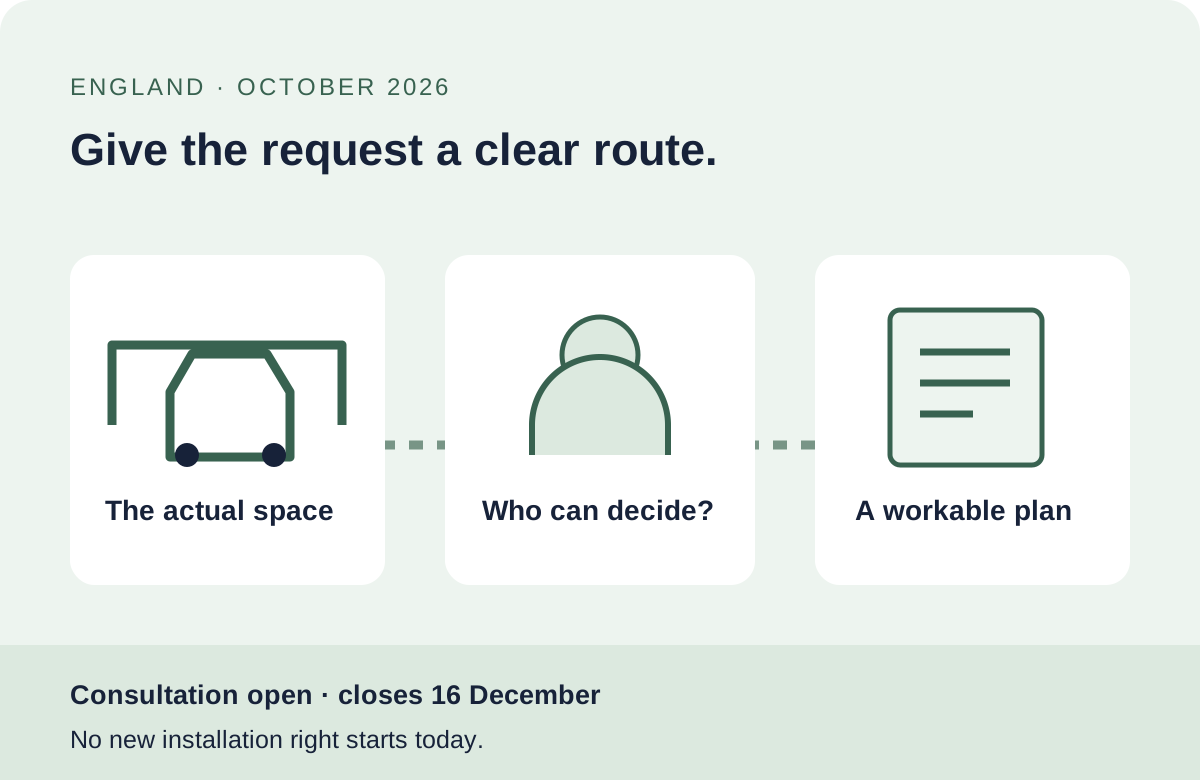
Start with the actual space. Check the plan, lease and tenancy record rather than assuming that a flat comes with a particular bay. Establish whether the resident has a dedicated space, an allocation that can change or access to communal parking. The cable route may cross land or shared parts beyond the space itself.
Write down who controls each part of the proposed installation. The person collecting the rent may not be the freeholder. A managing agent may coordinate the request while the decision belongs elsewhere. Ask the relevant party to confirm its role, then keep the resident informed about where the request has gone.
Our property management guide explains why the authority to arrange work needs to be clear in the management agreement. A charger request is a good example of work that needs a named decision maker, a defined scope and a record that the next person can understand.
Ask for a proposal you can assess
Ask the applicant for the proposed charger position, cable route and installation quotation. Get a competent installer to explain the electrical supply requirements, any network work and how the installation would affect shared areas. A photograph of a charger or an estimate for the unit alone does not explain the work at your building.
Consider how people will use the space once the equipment is there. A cable should not turn a route to the bins or entrance into an obstacle. Shared parking needs an operating arrangement that the people using it can understand. Discuss access, reservations and what happens when another car occupies the bay.
Keep the technical advice separate from the permission decision. Ask for missing information where it matters, record the reason for any concern and give the resident a useful next step. If a building scheme is being considered, explain the actual position and who is responsible rather than leaving an individual request unanswered.
Agree what happens after installation
A workable proposal needs more than an installation price. Agree who contracts with the installer and pays the electricity, who receives fault reports and who arranges repairs. Ask what happens to an account or subscription when the tenant leaves. Do not assume those details will look after themselves once the charger works.
Consider ownership, access for maintenance and any eventual removal or reinstatement. Record the agreed arrangements with the property documents and retain the installation and handover information. The property information questionnaire is a place to keep the wider utility and contact details alongside that record.
For a holiday let, assess the charger as a service you will have to operate between stays. Our amenities guide covers the cost and upkeep decision. State the actual connector, power, access and payment arrangements in the guest information. The residential consultation does not turn those guest arrangements into a new legal entitlement.
Keep planning and building rules separate
A second England consultation concerns Part S requirements for new buildings and major renovations. It proposes extending chargepoint requirements to covered car parks and reviewing the £3,600 connection cost threshold. That figure is not a new universal spending duty for landlords. These proposals do not require every existing rental car park to be retrofitted today.
Some planning rules do change today. SI 2026/1056, in force on 21 October, extends England’s permitted development routes for qualifying charging equipment and pavement embedded cable channels. The conditions and exclusions matter, and a channel must be installed by or for the highway authority, or with its authorisation. This is separate from landlord and freeholder permission. It is not permission to trail a loose cable across a pavement or a guarantee of a parking space.
If you are planning building work, ask the project’s competent advisers which current requirements apply to its scope. Keep the design and permissions assessment tied to the actual project. A resident’s request for a charger and a development’s building regulation obligations may involve some of the same people, but they need separate answers.
Use a real building problem in your response
Both consultations close at 23:59 on 16 December 2026. The official pages explain how to respond. If you manage flats, describe the permission chain, parking arrangement, information needed from an installer and the costs that arise after installation. Explain what would make the process work at the building rather than assuming every driveway and communal car park presents the same problem.
Keep personal details out of examples where they are not needed. A clear description of an unresolved cable route or shared bay arrangement can explain the issue without naming a tenant. This article reflects the proposals checked on 21 October. Recheck the government response and any future legislation before treating a proposed process as a duty.
Who keeps the property records?
Tell us about the property and the work you need help with. We can explain what a management agreement would cover and what stays with you or your adviser.