
Stoke-on-Trent, England · Small HMO conversions
Stoke brings small HMO conversions into planning control
Stoke-on-Trent’s council says its Article 4 direction took effect on 23 October. For an owner planning to turn a home into a small HMO, the useful next step is to check the actual use and mapped boundary before committing to the conversion.
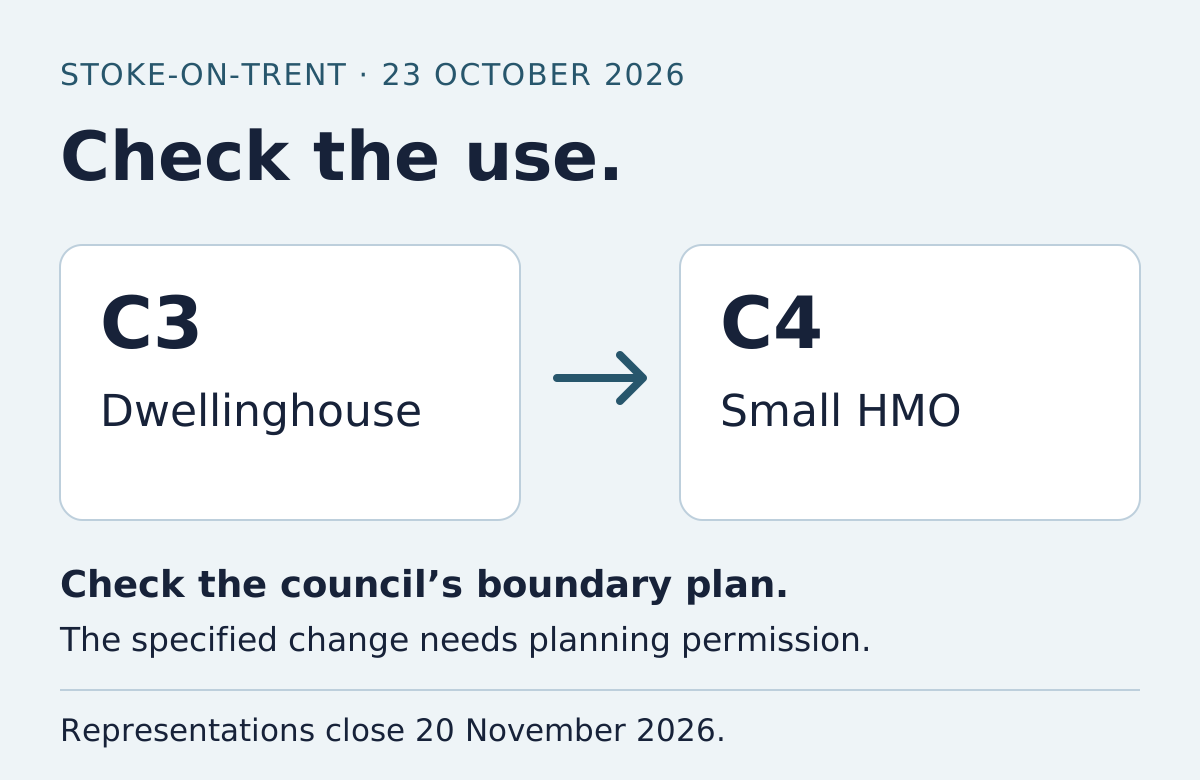
Check the property’s actual use, the council’s red boundary plan and the planning history before committing to a conversion.
The change concerns a specific planning use
Stoke-on-Trent City Council’s current HMO planning page reports that a citywide Article 4 direction came into force on 23 October 2026. The sealed direction, made that day, removes the specified permitted development route for changing a Class C3 dwellinghouse into a Class C4 house in multiple occupation on the land within its red boundary.
That route is Class L(b) of the General Permitted Development Order. The direction means the specified change needs a planning application. It is not a ban on HMOs or a promise that an application will be approved.
Timing can matter for a particular property. Schedule 3 links an immediate direction’s operation on land to notice service or publication. If a change of use was taking place around 23 October, ask the council or a planning adviser to establish the relevant facts rather than relying on this general announcement.
Check the building against the sealed plan
The council describes the direction as citywide, but the sealed plan defines the land affected. Use the property’s full address and the plan in the direction. A Stoke postal address alone is not a boundary check, particularly near a council border.
Set out the current lawful use and the intended occupation before asking whether the direction affects your plans. The schedule concerns C3 to C4. Do not assume that every shared property, larger HMO or short stay arrangement falls within that description.
Save the council’s answer with the plan reference and date. If the property is near the red line, seek a clear boundary answer before agreeing a purchase price or conversion budget that depends on the permitted development route.
Establish what an existing property can evidence
For a property already described as an HMO, start with its planning history and evidence of its actual use. Record when that use began and identify any permission, conditions or lawful development certificate. A sales description or an HMO licence does not by itself answer the planning question.
The direction withdraws a specified C3 to C4 development right. Its wording is not a basis for telling every existing HMO owner to seek retrospective permission, or for assuring every advertised HMO that its use is lawful. A change in occupation, layout or scale needs to be assessed on its own facts.
Use the blank planning record to keep the property history, boundary check and outstanding question together. Where evidence is incomplete, resolve that uncertainty before treating projected room income as income the property can lawfully earn.
A planning answer does not settle licensing
This direction concerns planning permission for the specified change of use. Check separately whether the proposed occupation needs an HMO licence and what the applicable conditions require. Planning permission and property licensing answer different questions.
For a purchase or management handover, keep those records distinct. Ask for the planning decision and its conditions, the relevant licence position and any unresolved correspondence. Do not let a single document labelled “HMO approved” stand in for both checks.
If the intended operation involves short stays, explain that use accurately rather than borrowing the C4 label. Our UK property permissions guide covers the wider planning, licensing, lease, finance and insurance questions.
Representations close on 20 November
The council invites representations from 23 October until 20 November 2026. Its current page gives the submission routes and says the direction, plan and supporting information can be inspected at the Civic Centre. Read those instructions before responding; a comment on a news article does not reach the consultation.
A useful response identifies the property or area concerned and explains the evidence behind the point being made. Distinguish a view on the direction from an application for permission for your own conversion. Making a representation does not authorise the proposed use.
The sealed document is an immediate direction, with a confirmation section that is currently blank. It says it expires on 23 April 2027 if the council has not confirmed it within the six month period. The council says representations will be considered before a confirmation decision. That is a condition on its continuation, not a confirmed date when the controls will disappear.
Tie the investment decision to the actual property
Before committing to a conversion, bring together the lawful use evidence, boundary answer and any application still needed. Put the next action against a named person and date. If the return depends on a new use, keep the budget and letting timetable conditional on the decision and its requirements.
For an application that will be decided from 31 October, also check the authority’s decision route. Our England planning decision update explains the separate national procedure starting then. That procedure does not remove Stoke’s Article 4 direction or grant permission for a particular conversion.