
England · Short let and serviced accommodation owners
England’s visitor levy Bill: what Bristol hosts should know
A Bill introduced on 4 November would let English strategic authorities introduce a visitor levy on qualifying accommodation. The West of England mayor supports the powers, making this relevant to Bristol hosts. There is no new levy to add to bookings today. The useful work now is understanding the proposal and keeping the records a future local scheme would need.
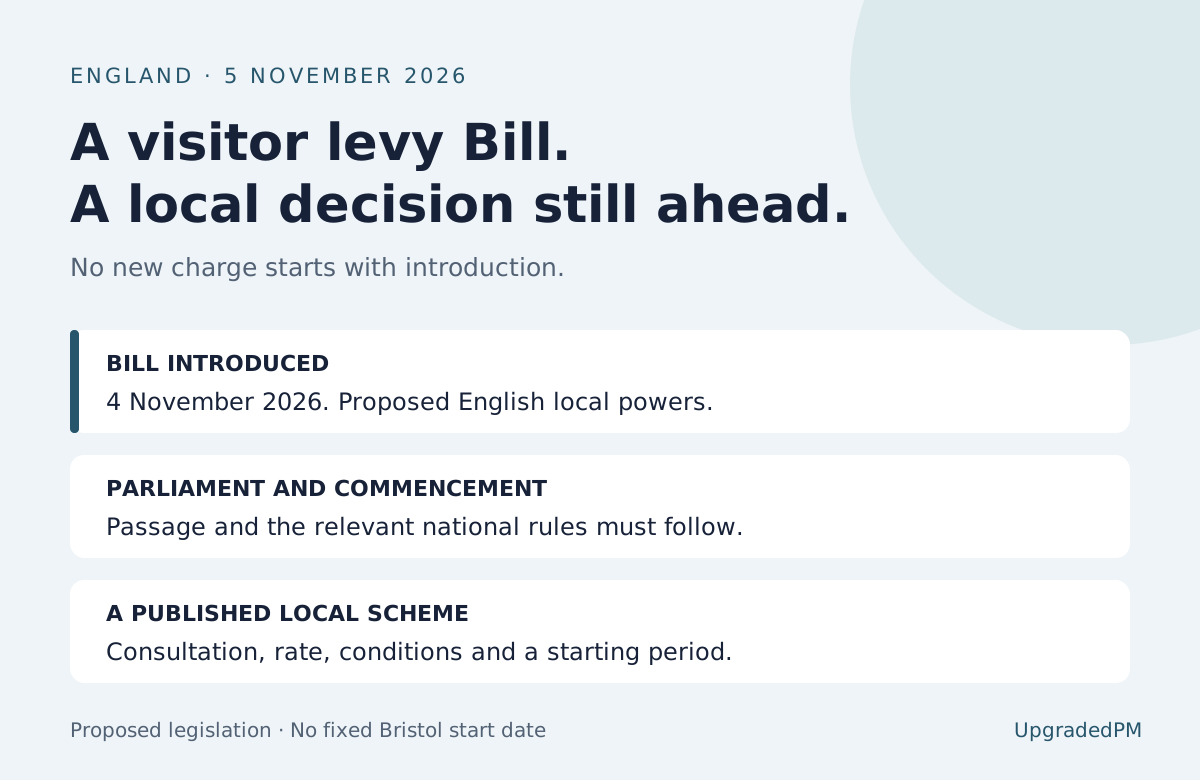
4 November 2026
Bill introduced
Parliament is considering proposed powers for English strategic authorities.
Further legislation
National powers
The Bill must pass and the relevant provisions must be brought into force.
Local decision
Any actual charge
A published local scheme would need its own rate, conditions and starting period.
Understanding the proposal
Stay length needs more than a night count
These examples explain the introduced Bill. There is no current England levy calculation here.
A weekend visit
A short visitor booking could fall within a future local scheme. The actual authority, enacted rules, threshold and published start would need checking before any charge.
A stay agreed for at least 28 successive days
The proposed exclusion looks at what the provider knows or reasonably believes about the guest’s occupation. Do not automatically apply a levy to the first 28 nights of an agreed longer stay.
A short stay is later extended
Keep the original dates and the dated extension together. The facts about occupation and the provider’s knowledge would matter. Final rules and guidance would be needed to resolve the actual treatment.
A proposed local power, with no Bristol start date
The Visitor Levy (England) Bill was introduced in the House of Commons on 4 November 2026. It would give strategic authorities a choice about introducing a levy in their areas. Parliamentary passage, commencement and a local decision still lie ahead. An announcement of support does not establish a charge on a Bristol booking.
The government’s announcement says receipts would stay in the area to support the visitor economy and local places. Before introducing a scheme, an authority would publish its proposal and an impact assessment, consult, consider responses and complete the applicable local decision process. No fixed Bristol implementation date is established by the Bill.
What the West of England connection means
Helen Godwin, the West of England mayor, welcomed the powers in the government announcement. The current Mayoral Combined Authority covers Bristol, Bath and North East Somerset, and South Gloucestershire. North Somerset belongs to the wider Local Enterprise Partnership, which is a different geographical grouping. Check the authority for the property itself when a local proposal appears.
A host in Bristol can use the next consultation to explain the practical effect on a real business. A business taking weekend city breaks may have different reporting needs from one accommodating a contractor for several weeks. Describe the actual stay pattern, the systems you use and the preparation time you would need. A general promise about tourism funding does not answer those operating questions.
The rate and the longer stay distinction matter
The proposed levy is percentage based. The announcement reports that ten mayors have committed to a rate no higher than 5%. That is a stated commitment, not a fixed England rate or a statutory 5% cap in clause 3. The final local prospectus would specify the rate. The Bill also leaves the occasional provider threshold to later rules; it does not establish a universal small host allowance today.
Read clause 8 of the introduced Bill before assuming every booking would be charged for its first 28 nights. It excludes occupation when the provider knows, or has reasonable grounds to believe, that the guest will occupy for 28 or more successive days. That period may include earlier days. This is more specific than the announcement’s summary of a first 28 day limit.
Keep the original booking, agreed dates and any extension history together. Those records explain what was known and when. Do not lengthen or relabel a booking to chase a proposed tax treatment. Whether a stay creates a tenancy or is genuinely visitor accommodation remains a separate question, covered in our property permissions guide.
Identify who would be responsible for the return
Clause 5 connects the proposed liability to the accommodation provider who accounts, or would account, for the accommodation income for Income Tax or Corporation Tax. Clause 14 allows arrangements with another person but keeps the provider’s obligations. An owner should not assume a booking platform or management company would automatically take care of the levy.
Ask how your existing management agreement handles records, guest charges and tax reporting. Identify who holds the booking history and who could reconcile it with the money received. You can clarify that division of work now. Wait for actual legislation, local rules and confirmed software support before changing charges or promising guests that a platform will collect them.
For a future cost review, retain the accommodation amount, VAT where applicable, other charges and any refunds separately. Clause 4 excludes VAT from its proposed base and requires a reasonable allocation where a payment covers other purposes. A platform’s net payout alone would not explain the original accommodation price. Our holiday let tax guide covers the separate taxation of rental profits.
Prepare a useful response before changing a price
Use the blank proposal record to keep the property’s authority, the dated source and unresolved questions together. When a local consultation is published, ask about the rate, threshold, treatment of changed stays, reporting arrangements and time to prepare. Support any claim about the cost to your business with an actual example, keeping guest names and private booking references out of a public response.
For now, keep the proposal out of current guest bills and use a clearly labelled scenario if you discuss possible future costs with an owner. A forecast is useful only when its assumed rate and eligible stays are visible. Revisit it when the enacted rules and the actual local prospectus are available.
The Bill concerns England. It does not replace Scotland’s separate framework or Welsh arrangements. Our Edinburgh return and payment article and Highland consultation article retain their own local scope. Do not copy one area’s dates or collection method into another.